Manufacturing Is Thriving In The South

From the Washington Post: Manufacturing Is Thriving In The South:

The Rust Belt’s manufacturing decline isn’t primarily about jobs going to Mexico or China. It’s about jobs going to Alabama, South Carolina, Georgia and Tennessee.

In 1970, the Rust Belt was responsible for nearly half of all manufacturing exports while the South produced less than a quarter. Today, the roles are reversed, it is the Rust Belt that hosts less than one-fourth of all manufactured exports and the South that exports twice what the Rust Belt does.

This migration didn’t happen by accident. It was driven by specific policy choices. States such as Tennessee, Alabama, South Carolina and Texas have aggressively courted manufacturers by promising business-friendly policy environments. 

Economic research suggests that labor conflict drove much of the decline of the Rust Belt. Right-to-work laws in the South, by contrast, created more operational flexibility and attracted capital. The average unionization rate in the Rust Belt is 13.3 percent; in the South, it’s 4.3 percent. Southern states’ political leaders are quite open about how they see right-to-work as foundational to their competitiveness.

The South offers cheaper electricity, a critical input for energy-intensive manufacturing. Ten states in the South have industrial electricity rates under 8 cents per kilowatt-hour; zero states in the Rust Belt do. Ohio has some of the country’s most restrictive wind-energy setback regulations. You know who doesn’t? Texas.

Southern states have built so much housing that they kept costs from becoming unaffordable. Last year, both North Carolina and South Carolina each built more than four times as much new housing per capita as Massachusetts, according to U.S. census data. Florida, Georgia, Texas, Tennessee, South Carolina and North Carolina, all built more housing per capita than all of Illinois, Ohio, Michigan, Pennsylvania, California, New York and Massachusetts. That is not just a 2024 dynamic. That is true for every single year going all the way back to 1993. Comparatively low-cost housing makes it easier to attract and retain workers, which further attracts capital, which adds yet more investment and jobs, and the virtuous cycle spins upward.

Taxes and permitting contribute, too. With the exceptions of Arkansas and Kentucky, the other 10 states that host an SEC football school are all in the top 15 in terms of low state-level taxes. Permitting processes move faster, too. To give just one example, Georgia has a certified-site program that can fast-track construction projects. With regard to land, as one industry analyst put it: “For big projects that are going to employ three, four, five thousand people, you can find free land — zero cost land.” Immigration helps a lot, as well. More immigrants live in the South than any other region of the country. The region with the fewest immigrants? The Midwest. Immigrants promote growth, makes the workforce more robust, and create the goods and services that support manufacturing.

In 1992, there was not a single auto plant in Alabama. Today, Alabama is the No. 1 auto-exporting state, producing more than 1 million vehicles a year. That’s brought more than 50,000 jobs and billions of dollars in investment. Instead of a Big Three, it has a Big Five (Honda, Toyota, Hyundai, Mercedes-Benz and Mazda) along with an ever-expanding web of suppliers.

Even when companies do reshore operations, they are overwhelmingly choosing Southern states, not the Rust Belt. That hyper-automated Black & Decker factory went to North Carolina, not Pennsylvania. Manufacturing doesn’t chase nostalgia; it follows the bottom line.

Americans Are Delaying Marriage, Children & Home Buying

3.6 million babies were born in 2024, down from the peak of 4.3 million in 2007, marking a 40-year low. This is especially significant because the US population has grown by approximately 108 million people since 1983.

Changes in family formation are part of a broader trend where major life events happen later. Among today’s 30-year-olds:

  • 70% live independently (down from 83% in 1984).
  • Only 48% have been married (down from 78% in 1984).
  • Only 33% own a home (down from 47% in 1984).

These shifts didn’t just start recently. Each generation since the baby boomers has reached these milestones later than the previous one.

Americans are waiting significantly longer to purchase homes. The typical first-time homebuyer is now 38 years old, compared to 33 in 2020 and an average of 31 between 1993 and 2018. This delayed homeownership creates increased rental demand, with 72% of US renters now age 30 or older—an all-time high.

Source: John Burns Research

Multifamily Ownership Is Highly Fragmented

  • No one player owns more than 1% of U.S. apartments.
  • The top 50 owners combined own only 11% of U.S. apartments.
  • In most other major industries, a single company typically owns more market share than the top 50 largest apartment owners combined have of the apartment market.
  • The low teens ownership percentage range has been pretty stable for decades:

It’s interesting to note that while the largest apartment owners actually have fewer units than they did 11 years ago, the largest third-party property managers have growth the number of units they manage significantly.

Source: Jay Parsons

Multifamily Demand & Absorption Continue To Set Records

  • In the January to March quarter, the U.S. absorbed over 138,000 market rate apartment units, marking the highest 1st quarter demand on record.
  • Occupancy continued to tick up modestly throughout the early months of 2025 to stand at 95.2% in March. This was the highest reading seen since October 2022.
  • Effective rents grew 0.75% in March. In turn, effective rents grew 1.1% in the year-ending March 2025, which marked the highest reading since June 2023.

Source: RealPage

Multifamily Supply Volume Has Peaked

A little over 576,700 units were delivered in the year-ending 1st quarter 2025. That was slightly below the all-time peak of 585,200 units from calendar 2024. From this point on, delivery volumes are scheduled to drop off for the next few years as developers wrap up the current pipeline of projects.

Annual supply is scheduled to drop to about 431,200 units by the end of 2025. After that, deliveries are expected to fall off even further, returning to more historic norms by 2026 if current construction timetables hold.

Source: RealPage

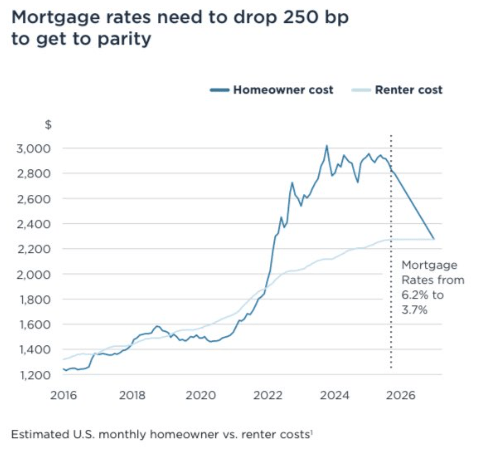
Homeowners Need To Earn $50,000 More Than Renters To Afford Monthly Payments

Americans need to earn $116,633 per year to afford the median priced home for sale. That’s 81.8% more than the $64,160 they need to afford the typical apartment for rent—and the gap has been widening. 

The cost of buying a home is rising faster than the cost of renting, which is why there’s a growing gap between the income someone needs to afford their own home versus an apartment. The median home-sale price rose 4.5% year over year to $423,892 in February, and has been growing at roughly that pace for months.

The typical U.S. household earns an estimated $86,382—roughly $30,000 less than the income required to afford the typical home for sale. Meanwhile, the median asking rent rose just 0.2% year over year.  

Source: Redfin