The average 10-year treasury rate since 1871 is 4.46%.

The average 10-year treasury rate since 1871 is 4.46%.

The latest MSCI report showed multifamily property prices were down 0.4 percent month-over-month in May and down 1.12 percent year-over-year.
It appeared multifamily prices had finally bottomed in late 2024, however, they have been falling for the last 4 months and are now at prices last seen in April 2021, down 19.7% from the peak.

Source: Yield PRO
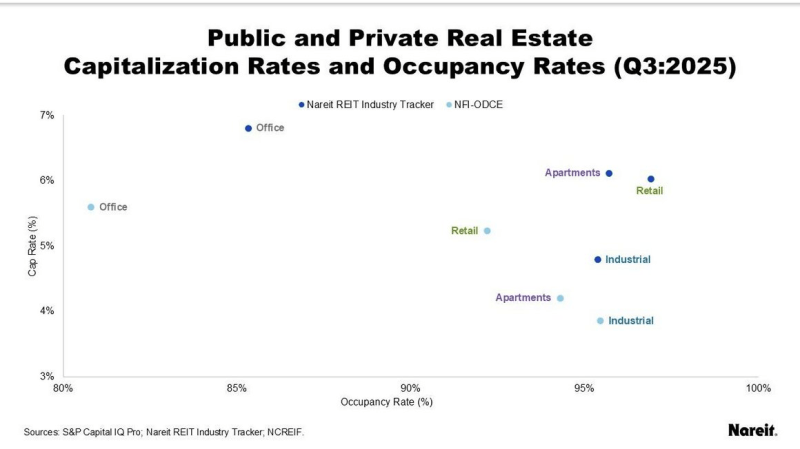
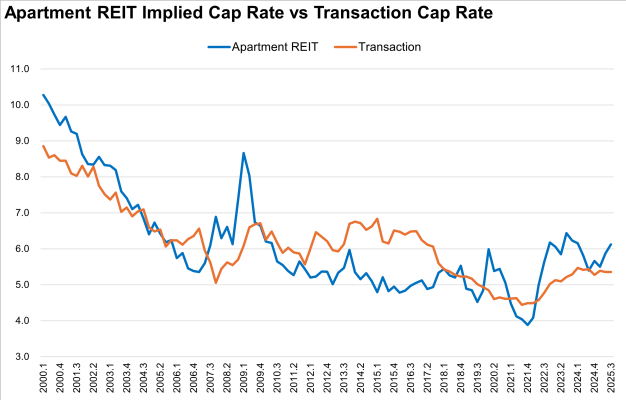
Cap rates do not move on a one-to-one basis with the 10-year US Treasury. The spread narrows and widens based on other factors such as investor perceptions of risk, relative market liquidity and growth in property income. The lines below:

Source: MSCI
209,000 new market-rate apartment units started construction across the U.S. year-ending 1st quarter 2025. There were 708,000 units were rented over the same period, marking the highest demand-to-starts ratio since 2010.

Source: RealPage
Have been at historic lows for multifamily since 2022 (yellow line below):

Materials make up only 20% of total costs, limiting the impact tariffs have on new construction.

Source: Jay Parsons and Avalon Bay
Though operational expenses in multifamily assets continue to grow and sit roughly 39% above where they were prior to the pandemic, the pace of increase has slowed to the lowest level since early 2021. Across nine operational expense categories, all but two – utilities and payroll – moderated over the last 12 months.

The most significant decline has been in insurance growth, which fell to just over 7% on an annualized basis in 1st quarter 2025. That compares to an incredible increase of 33.5% just one year prior. Taxes, another pain point for property owners as they account for roughly 30% of total OPEX costs, also registered a substantial drop. This time last year, taxes were growing by nearly 4% annually on average. But through the end of March 2025, the cost of taxes per unit on a national level have fallen 50 basis points (bps) year-over-year.

This theme of moderation has been seen across the country. All regions of the U.S. have seen expense growth fall below the change rates reported annually at the beginning of 2023 and 2024, albeit at varying levels. In total, two-thirds of regions registered an annual average expense growth in 1st quarter 2025 below their average growth in the five years ending 2019.

Source: RealPage
There’s a burgeoning business in companies that will pay tenants’ rent if they can’t, but the price for the service isn’t cheap. The fee can be as low as 75% of one month’s rent, up to 150%.
If a renter defaults on a lease, the guarantor may cover the payments, but the renter is still on the hook. In this instance, the money is no longer owed to the landlord but to the guarantor.
A study from consulting firm Verified Market Research estimates the global rent-guarantor market will generate $775 million in revenue this year, which is up nearly 10% from 2024. And by 2032, it could nearly double and become a $1.53 billion industry, according to the study.
Source: Morningstar
U.S. apartment transactions eased during the first three months of 2025, following historical trends. However, on a year-over-year basis, apartment sales (total dollar volume, number of properties, number of units and price per unit) were up.

Roughly 1,277 apartment properties changed hands at a value of $30 billion during 1st quarter 2025, according to MSCI Real Capital Analytics. Overall sales volumes were up 36% year-over-year but were well below 4th quarter 2024 levels when around 1,848 properties changed hands for nearly $48.2 billion. In addition, recent activity was well below the $53.6 billion quarterly average over the past five years.
The average price per unit remained high at $211,356 in 1st quarter, registering above $200,000 for 13 of the past 15 consecutive quarters. Prior to 2021, the per unit pricing never exceeded that threshold and averaged $151,000 from 2015 to 2019. Meanwhile, cap rates have been rising since reaching a pandemic-era low of 4.67% in 2nd quarter 2022. For apartment transactions occurring in 1st quarter 2025, cap rates averaged 5.65%, the highest in nearly nine years.

Source: RealPage

Source: Gavin Campbell