Cap Rates Do Not Always Move With The 10-Year Treasury

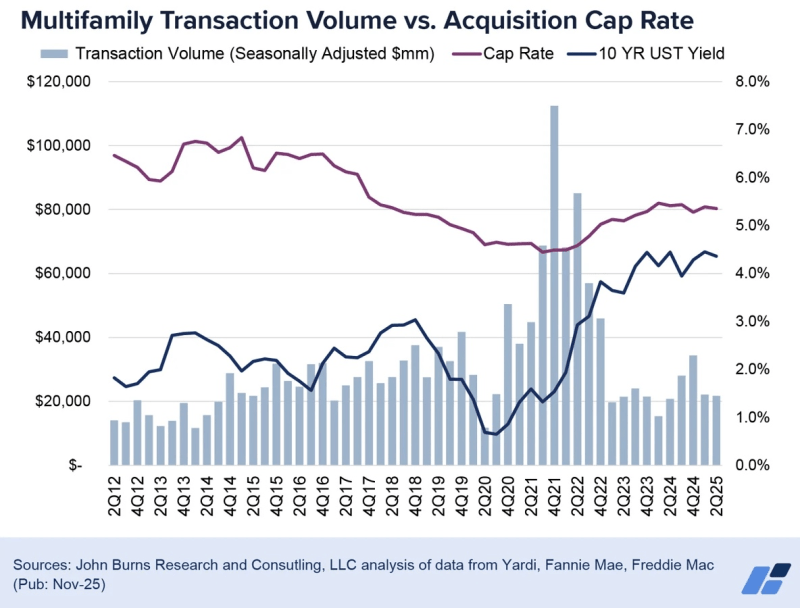
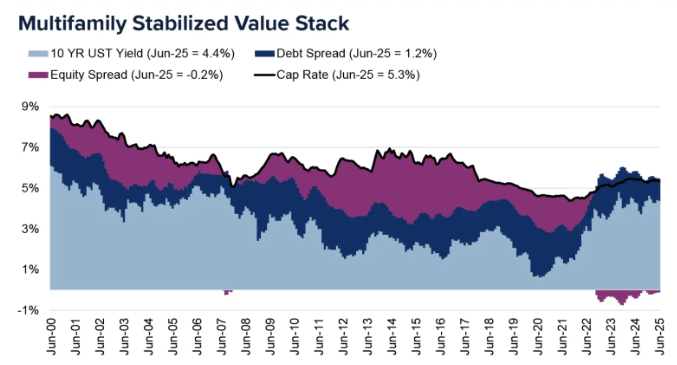
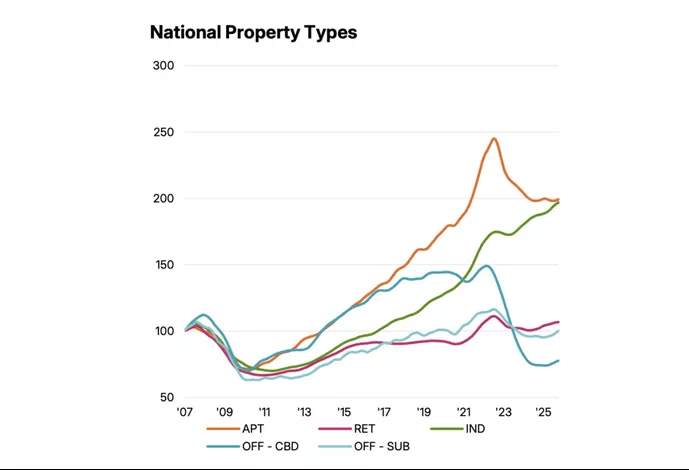
Cap rates do not move on a one-to-one basis with the 10-year US Treasury. The spread narrows and widens based on other factors such as investor perceptions of risk, relative market liquidity and growth in property income. The lines below:

  • Purple: 10 Year Treasury
  • Orange: Apartments
  • Green: Industrial
  • Red: Retail
  • Dark Blue: Office (Central Business District)
  • Light Blue: Office (Suburban)

Source: MSCI

Multifamily Expense Growth Has Slowed Dramatically

Though operational expenses in multifamily assets continue to grow and sit roughly 39% above where they were prior to the pandemic, the pace of increase has slowed to the lowest level since early 2021. Across nine operational expense categories, all but two – utilities and payroll – moderated over the last 12 months.

The most significant decline has been in insurance growth, which fell to just over 7% on an annualized basis in 1st quarter 2025. That compares to an incredible increase of 33.5% just one year prior. Taxes, another pain point for property owners as they account for roughly 30% of total OPEX costs, also registered a substantial drop. This time last year, taxes were growing by nearly 4% annually on average. But through the end of March 2025, the cost of taxes per unit on a national level have fallen 50 basis points (bps) year-over-year.

This theme of moderation has been seen across the country. All regions of the U.S. have seen expense growth fall below the change rates reported annually at the beginning of 2023 and 2024, albeit at varying levels. In total, two-thirds of regions registered an annual average expense growth in 1st quarter 2025 below their average growth in the five years ending 2019.

Source: RealPage

Companies Are Replacing Mom & Dad As Guarantors For Renters

There’s a burgeoning business in companies that will pay tenants’ rent if they can’t, but the price for the service isn’t cheap. The fee can be as low as 75% of one month’s rent, up to 150%.

If a renter defaults on a lease, the guarantor may cover the payments, but the renter is still on the hook. In this instance, the money is no longer owed to the landlord but to the guarantor.

A study from consulting firm Verified Market Research estimates the global rent-guarantor market will generate $775 million in revenue this year, which is up nearly 10% from 2024. And by 2032, it could nearly double and become a $1.53 billion industry, according to the study.

Source: Morningstar

Q1 2025 – Multifamily Transactions, Price Per Unit & Cap Rates

U.S. apartment transactions eased during the first three months of 2025, following historical trends. However, on a year-over-year basis, apartment sales (total dollar volume, number of properties, number of units and price per unit) were up.

Roughly 1,277 apartment properties changed hands at a value of $30 billion during 1st quarter 2025, according to MSCI Real Capital Analytics. Overall sales volumes were up 36% year-over-year but were well below 4th quarter 2024 levels when around 1,848 properties changed hands for nearly $48.2 billion. In addition, recent activity was well below the $53.6 billion quarterly average over the past five years.

The average price per unit remained high at $211,356 in 1st quarter, registering above $200,000 for 13 of the past 15 consecutive quarters. Prior to 2021, the per unit pricing never exceeded that threshold and averaged $151,000 from 2015 to 2019. Meanwhile, cap rates have been rising since reaching a pandemic-era low of 4.67% in 2nd quarter 2022. For apartment transactions occurring in 1st quarter 2025, cap rates averaged 5.65%, the highest in nearly nine years.

Source: RealPage

Manufacturing Is Thriving In The South

From the Washington Post: Manufacturing Is Thriving In The South:

The Rust Belt’s manufacturing decline isn’t primarily about jobs going to Mexico or China. It’s about jobs going to Alabama, South Carolina, Georgia and Tennessee.

In 1970, the Rust Belt was responsible for nearly half of all manufacturing exports while the South produced less than a quarter. Today, the roles are reversed, it is the Rust Belt that hosts less than one-fourth of all manufactured exports and the South that exports twice what the Rust Belt does.

This migration didn’t happen by accident. It was driven by specific policy choices. States such as Tennessee, Alabama, South Carolina and Texas have aggressively courted manufacturers by promising business-friendly policy environments. 

Economic research suggests that labor conflict drove much of the decline of the Rust Belt. Right-to-work laws in the South, by contrast, created more operational flexibility and attracted capital. The average unionization rate in the Rust Belt is 13.3 percent; in the South, it’s 4.3 percent. Southern states’ political leaders are quite open about how they see right-to-work as foundational to their competitiveness.

The South offers cheaper electricity, a critical input for energy-intensive manufacturing. Ten states in the South have industrial electricity rates under 8 cents per kilowatt-hour; zero states in the Rust Belt do. Ohio has some of the country’s most restrictive wind-energy setback regulations. You know who doesn’t? Texas.

Southern states have built so much housing that they kept costs from becoming unaffordable. Last year, both North Carolina and South Carolina each built more than four times as much new housing per capita as Massachusetts, according to U.S. census data. Florida, Georgia, Texas, Tennessee, South Carolina and North Carolina, all built more housing per capita than all of Illinois, Ohio, Michigan, Pennsylvania, California, New York and Massachusetts. That is not just a 2024 dynamic. That is true for every single year going all the way back to 1993. Comparatively low-cost housing makes it easier to attract and retain workers, which further attracts capital, which adds yet more investment and jobs, and the virtuous cycle spins upward.

Taxes and permitting contribute, too. With the exceptions of Arkansas and Kentucky, the other 10 states that host an SEC football school are all in the top 15 in terms of low state-level taxes. Permitting processes move faster, too. To give just one example, Georgia has a certified-site program that can fast-track construction projects. With regard to land, as one industry analyst put it: “For big projects that are going to employ three, four, five thousand people, you can find free land — zero cost land.” Immigration helps a lot, as well. More immigrants live in the South than any other region of the country. The region with the fewest immigrants? The Midwest. Immigrants promote growth, makes the workforce more robust, and create the goods and services that support manufacturing.

In 1992, there was not a single auto plant in Alabama. Today, Alabama is the No. 1 auto-exporting state, producing more than 1 million vehicles a year. That’s brought more than 50,000 jobs and billions of dollars in investment. Instead of a Big Three, it has a Big Five (Honda, Toyota, Hyundai, Mercedes-Benz and Mazda) along with an ever-expanding web of suppliers.

Even when companies do reshore operations, they are overwhelmingly choosing Southern states, not the Rust Belt. That hyper-automated Black & Decker factory went to North Carolina, not Pennsylvania. Manufacturing doesn’t chase nostalgia; it follows the bottom line.