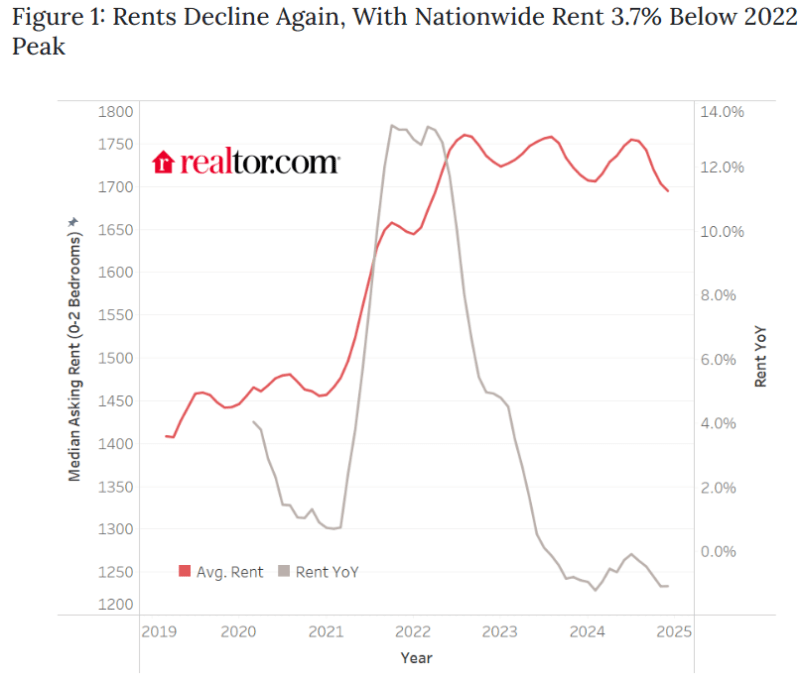
It was the seventeenth consecutive month of year-over-year rent decline for 0-2 bedroom properties.
Rents nationally were down by 1.1% from the previous year.
The median asking rent fell to $1,695, dipping below $1,700 for the first time since April 2022.
Median rent fell consistently across all units of all bedroom counts. Studios were down 1.3% year-over-year, 1-bedrooms and 2-bedrooms were both down 0.9%.
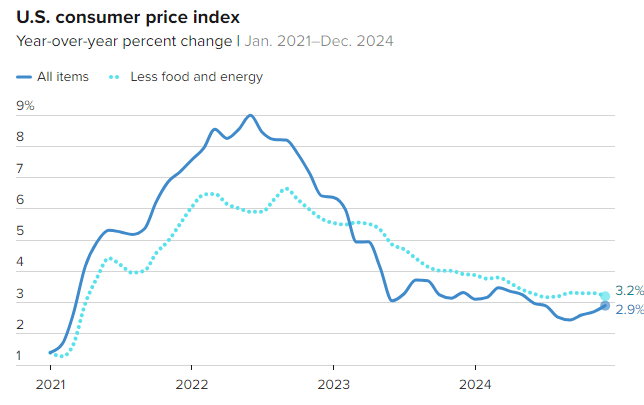
What It Is: Tracks the price change for of a basket of common items people use in their daily lives, such as food, clothing, housing, transportation, and healthcare.
Monthly reading was up 0.4% putting the 12-month inflation rate at 2.9%, in line with market expectations
Core CPI (removing food and energy) was 3.2%, below the previous month and better than the 3.3% the market expected
What It Means: The data coming in slightly better than consensus estimates increase the market odds for Fed cuts in the months ahead
What It Is: Tracks how much businesses are charging for the things they make, before they reach consumers. It’s like looking at the prices in the factory, not the store.
The monthly change was only 0.2% vs. expectations of 0.4%
Core PPI was unchanged month-over-month (0.0%)
What It Means: A cooler than expected PPI report, showing lower than expected inflation, gives the Fed more room to cut rates in the months ahead
Before everyone freaks out that rate cuts are causing the economy to surge, take a look at the monthly NFP averages since covid:
NFP (Non Farm Payroll Report) Monthly Average Of New Jobs: 2021: 604k 2022: 377k 2023: 251k 2024: 186k
Friday’s report showed a gain of 256k jobs – pretty much the average of 2023. Isn’t that a good thing? It’s still 60% lower than 2021. 600k per month is overheated. 250k per month isn’t.
The hiring rate fell to 3.3%, the lowest level since 2013. Professional services hiring is at 2009 levels. Private payrolls averaged 149k last year vs 192k in 2023. Plus, government/healthcare still made up 40% of the jobs – let’s see how that holds up under the DOGE microscope. Call me back in four months after revisions. This feels mostly like positive business sentiment from the Republican sweep. And more like stabilization, not spiking.
The median asking rent fell 0.3% year over year in December to $1,594, the lowest since March 2022
Rents were down 0.1% from a month earlier, and down 6.2% from the August 2022 high of $1,700.
The median asking rent per square foot dropped 1.9% year over year in December to $1.78 and fell 0.1% month over month.
Asking rents fell across all bedroom counts for the sixth consecutive month
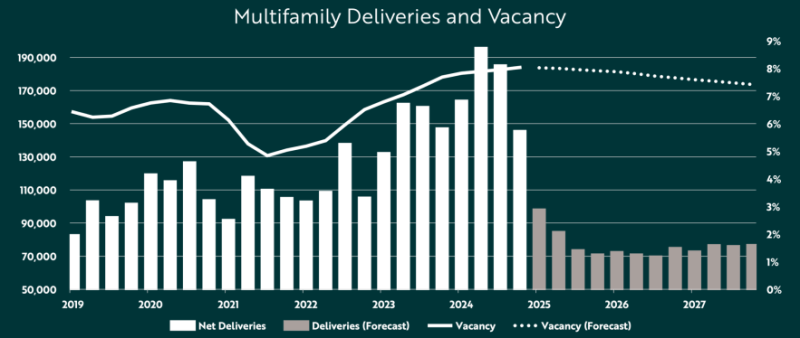
Asking rents have been falling because an influx of supply has left apartment owners with rising vacancies. Apartment completions surged 58.1% year over year to the highest level since 1974 in the third quarter—the most recent period for which data is available. As a result, the vacancy rate for buildings with five or more units rose to 8%, the highest since early 2021.
The future is never the same as the past, but the Fed’s 2.0% inflation target is a level we’ve never hit, other than the anomalous period in the 2010s following the Great Financial Crisis.
________________________________________
The cap rates on single-family investment homes (which have not experienced the price declines of multifamily) are now trading below the 10-year treasury rate.
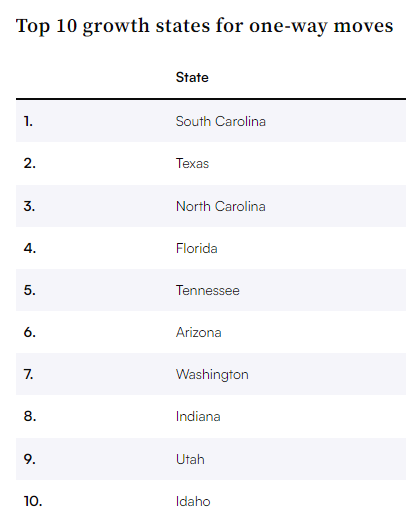
Growth rankings are determined by each state’s net gain (or loss) of customers utilizing one-way U-Haul equipment in a calendar year. The index is compiled from over 2.5 million moving container transactions that occur annually.
South Carolina climbed three spots in the rankings to unseat Texas, which was number 1 the previous three years. It was the first time South Carolina reached number 1 on the rankings, and North Carolina was close behind at number 3.
California experienced the greatest net loss of do-it-yourself movers, and ranked 50th for the fifth consecutive year in 2025, followed by Massachusetts, New Jersey and New York.
North Carolina’s Research Triangle – the area between Chapel Hill, Raleigh and Durham – has become one of the country’s fastest growing tech hubs largely thanks to its access to talent from some of the top universities in the country (Duke, North Carolina at Chapel Hill and North Carolina State) and low cost of living.
The state’s pro-business environment and low taxes have attracted tech giants like Meta, Apple and Amazon investing billions in the area. In 2024, the state was ranked second on CNBC’s America’s Top States For Business list.
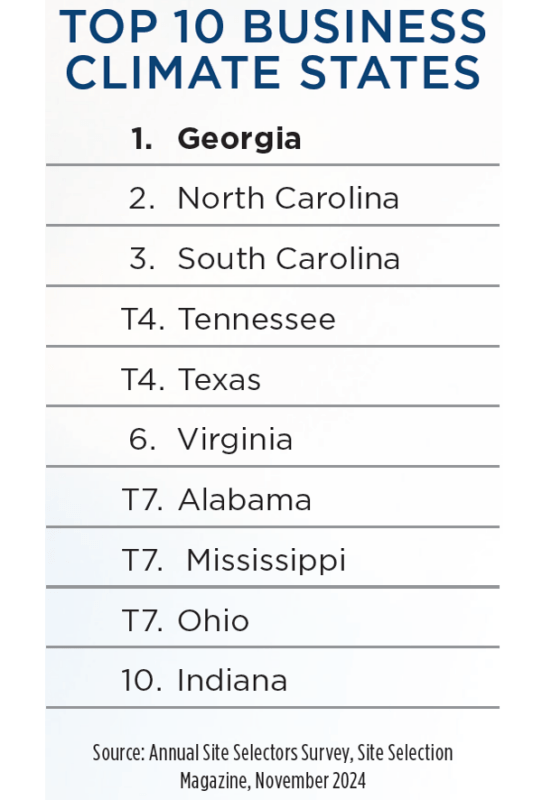
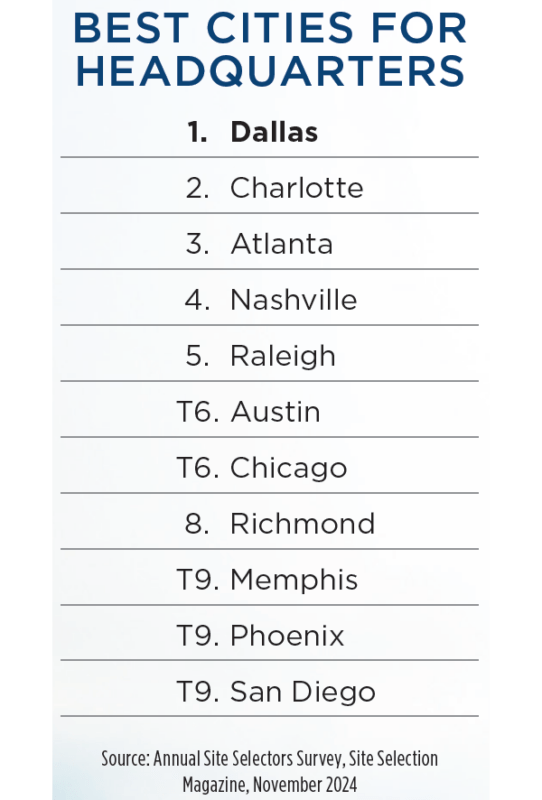
In the annual Site Selectors Survey, Georgia received the most votes to dethrone last year’s winner, Texas, for Best Business Climate in the nation. North Carolina finished just behind Georgia in the runner-up spot, followed by South Carolina in third. South Carolina garnered the most votes for the state they believe has the best manufacturing workforce in America.
What it is: a monthly report that gives an estimate of how many jobs were added or lost in the U.S. private sector during the previous month. It’s published by ADP, a company that processes payrolls for businesses
122,000 jobs in December, worse than the 140,000 expected. The lowest number since August.
Wage growth also cooled: workers who changed jobs saw a 7.1% increase in pay, while those who stayed saw a 4.6% gain. These were the lowest since mid-2021.
What it means: weaker jobs reports make it more likely the Fed will cut rates
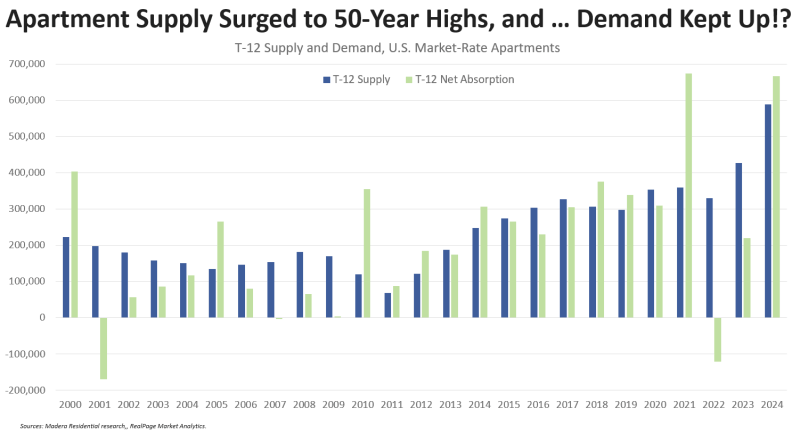
From RealPage: U.S. apartment demand hit its highest level in nearly three years in 2024’s 4th quarter and easily outpaced concurrent new supply. “The U.S. apartment market has responded to the fears of oversupply with resounding appetite,” RealPage Chief Economist Carl Whitaker said.
In the October to December 2024 quarter, the U.S. absorbed 230,819 market rate apartment units, buoying annual demand to 666,699 units – the highest annual recording since 1st quarter 2022.
As such, the imbalance between supply and demand has reversed, allowing for the first true absorption surplus of apartment demand since mid-2022.
With demand outpacing supply, the U.S. posted a meaningful annual occupancy bump to stand at 94.8% in December.
“The data suggests that the multifamily industry has ‘found the floor’ in 2024,” Whitaker said. “And it’s equally important to note that the past year has set the stage for operators to view the upcoming year as arguably the most ‘normal’ set of conditions seen since the turn of the decade. While the theme of some locally soft apartment markets will carry forward into 2025 (largely areas working through massive waves of new supply), it’s becoming increasingly evident that the apartment market at-large turned a corner in 2024 with 2025 setting up to be a year characterized by continued improvement.”
More from Jay Parsons on the incredible multifamily demand numbers:
Renters signing new leases for market-rate, professionally managed apartments are coming in well qualified with rent-to-income ratios below 23%.
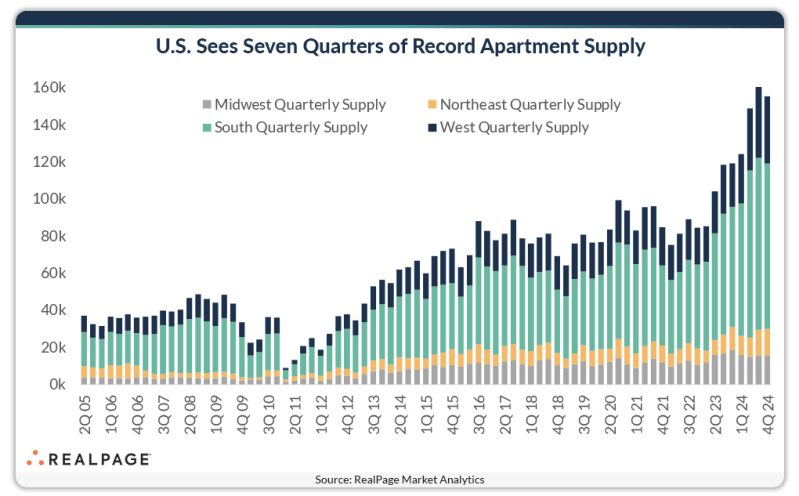
Imagine what would be happening with rents right now if not for new apartment supply nearing 600k units in 2024 — the biggest number in 50 years. We just saw the 2nd best year on record for apartment demand.
___________________________________________
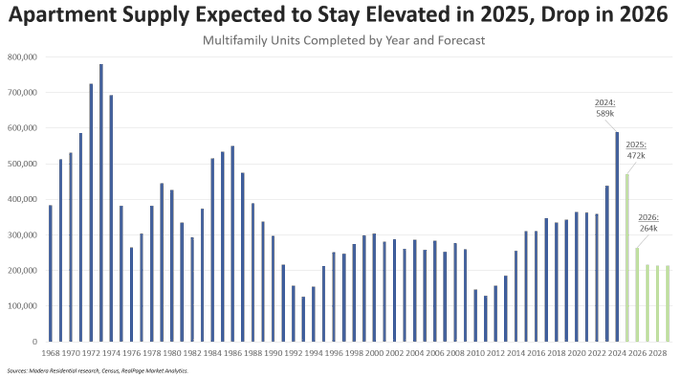
From Jay Parsons: New apartment supply in 2024 hit the highest levels since the mid-1970s. That’s why rent growth was flat nationally (and negative in many markets) even though demand was massive.
2024 was the supply peak, but more supply hits in 2025 before the big plunge in 2026. Starts are down to 10-year lows, and the ongoing total construction volume is nearly half it was at peak a couple years ago, so there’s good evidence to support the forecasts for low supply levels by 2026.
Rents rose 0.6% in December, typically a difficult seasonal month to see gains
Rents rose 0.9% year-over-year in 2024
___________________________________________
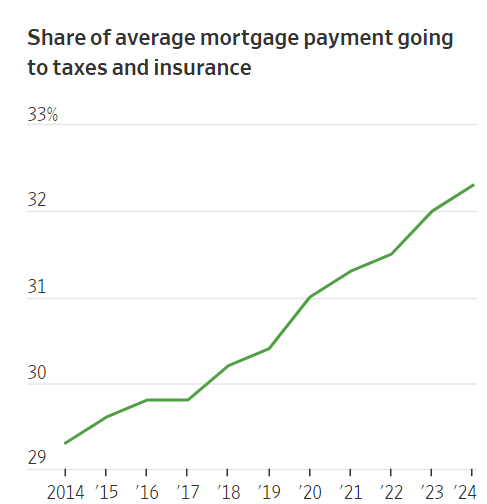
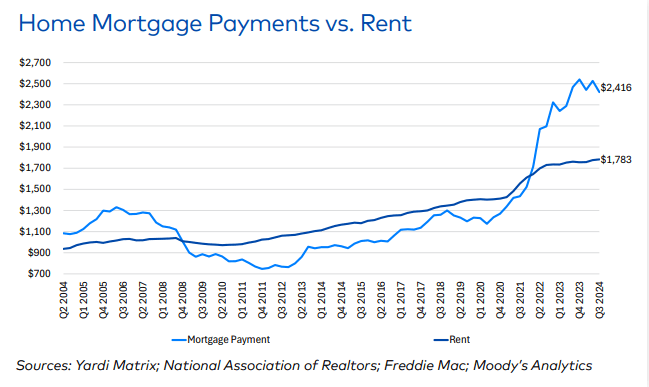
It’s not just increasing monthly mortgage costs raising the barrier to homeownership and keeping more Americans renting. The cost of insurance and taxes for homeowners continues to rise dramatically. From the Wall Street Journal this week:
What it is: The main jobs report for the United States released monthly. Includes how many total jobs were added or lost, the unemployment rate, wages and changes within industries.
The number came in scorching hot: 256,000 jobs added vs. expectations of 165,000
The two previous months were revised lower by a combined 8,000 jobs
The unemployment rate dropped from 4.2% to 4.1%
What it means: While a strong employment market is positive for tenants paying their rent, it reduces the likelihood for Fed rate cuts in the months ahead.
What it is: A survey where people are asked about their views on inflation. How much they think prices will go up in the short term (next year) and longer term (5 years ahead)
Surged to 3.3% for both the short and longer term, the highest reading on the longer term since 2008
What it means: If consumers and businesses expect inflation/prices to be higher in the future it causes them to make purchases sooner, which actually exacerbates the actual inflation in the economy (a self-fulfilling prophecy). The Fed tracks this data closely and will be less likely to reduce rates if inflation expectations are high
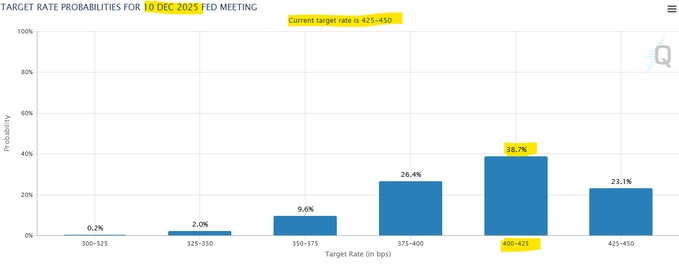
Following the BLS Jobs Report and UMich Inflations Expectation Report discussed above, the market is now pricing in only one rate cut in all of 2025: a 25-basis point cut bringing the Fed Funds rate down to 4.00 – 4.25% by year end.
As a reminder the 10-year treasury yield is historically 1.50% higher than the Fed Funds rate, which would put the 10-year treasury at 5.50% (it is at 4.75% today).
The number of Americans filing new applications for unemployment benefits fell to an 11-month low last week at only 201,000, well below the forecast of 218,000.
What it means: a stronger jobs market makes the Fed less likely to cut rates
The Prices Paid in the ISM (manufacturing and services) report came in at 64.4, up from 58.2 the previous month, showing an explosion higher in prices paid
The Jobs Openings and Labor Turnover Survey (JOLTS) showed a higher-than-expected number of openings this month at 259,000, and also revised up an extremely strong previous month from 372,000 to 467,000
What it means: Rising ISM prices and a high level of jobs opening lowers market expectations for Fed rate cuts in 2025 and sent rates higher following the data release
The national median monthly rent fell 0.6% month-over-month
Year-over-year rents were also down 0.6%
Since the second half of 2022, rent prices have continued to ebb and flow with the seasons as they typically do, but with the overall trajectory trending modestly downward.
The national median rent has now fallen below its August 2022 peak by a total of 4.8 percent.
The median time a unit is on the market to rent reached 36 days this month; the highest reading seen for this metric in any month going back to the start of 2019, when the data series begins.
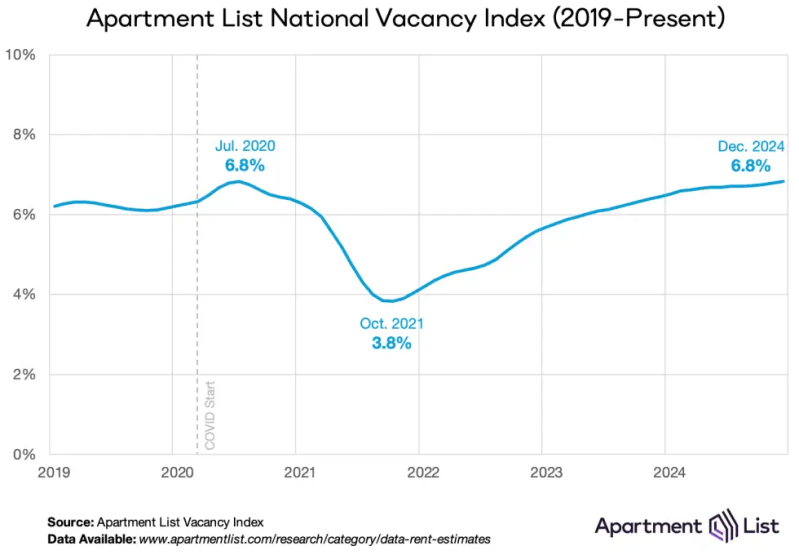
The national vacancy index continues trending up slowly and currently sits at 6.8 percent, the highest reading since the onset of the pandemic.
2024 saw the most new apartment completions since the mid-1980s, and with nearly 800 thousand units still in the construction pipeline, the supply boom has runway to continue into 2025.
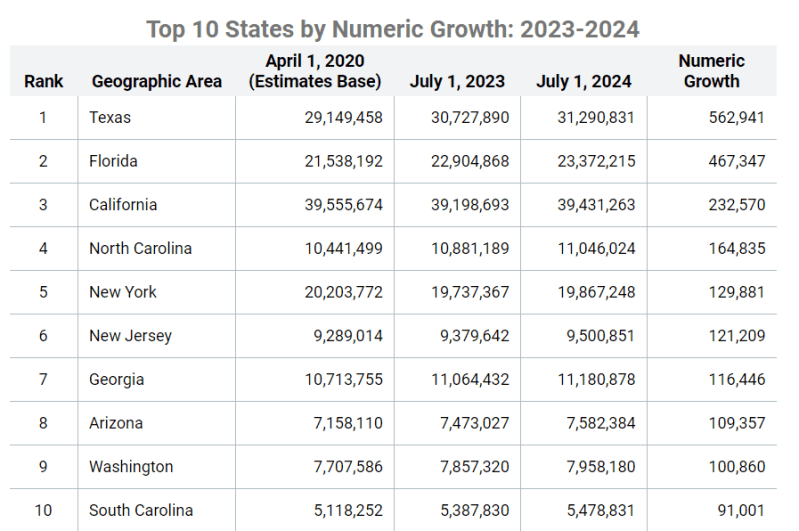
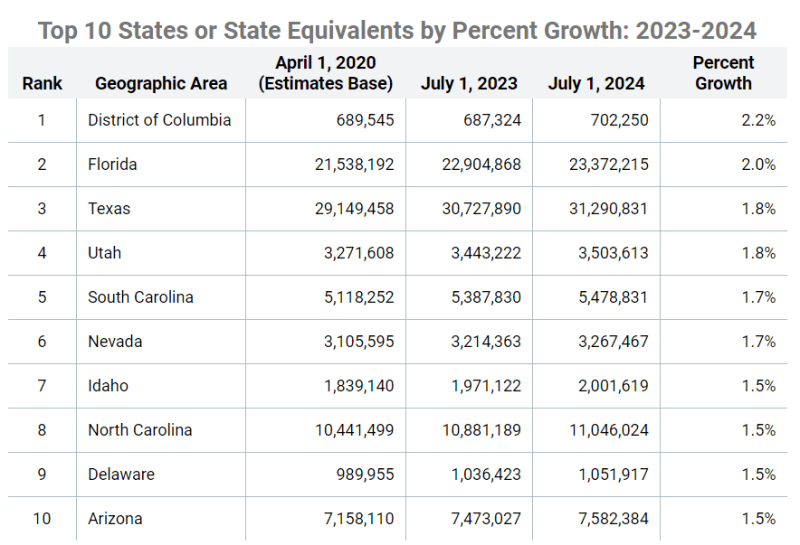
The U.S. Census Bureau released the 2024 population growth statistics this week.
Total U.S. Growth:
Net international migration, which refers to any change of residence across U.S. borders (the 50 states and the District of Columbia), was the critical demographic component of change driving growth in the resident population. With a net increase of 2.8 million people, it accounted for 84% of the nation’s 3.3 million increase in population between 2023 and 2024. This reflects a continued trend of rising international migration, with a net increase of 1.7 million in 2022 and 2.3 million in 2023.
Natural increase also contributed to the population growth, as births outnumbered deaths by nearly 519,000 between 2023 and 2024. This marks an increase from the historic low in 2021 when natural increase was just over 146,000, but it was still well below the highs in prior decades.
The South:
At nearly 132.7 million residents, the South is the most populous region. With a population gain of nearly 1.8 million — a change of 1.4% between 2023 and 2024 — the South added more people than all other regions combined, making it both the fastest-growing and largest-gaining region in the country.
The largest contributing component to this growth was international migration, which added 1.1 million people. Domestic migration netted another 411,004 residents. The South was the only region with positive net domestic migration, where the number of people entering the region exceeded those leaving. Natural increase also contributed 218,567 to the growing region.
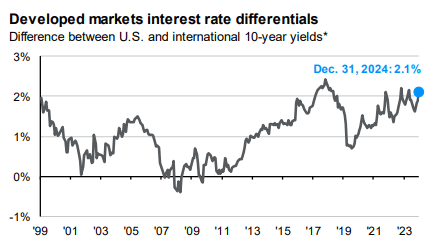
From J.P. Morgan’s Q1 2025 Guide To The Markets, a nice visual of how much higher the 10-year treasury is in the United States is vs. the rest of the developed world. This makes U.S. bonds look more attractive to investors and helps keep a cap on yields:
From J.P. Morgan’s 2025 Eye On The Market, for those concerned about a reduction in Federal employment impacting multifamily renters, the 3 million federal workers employed are the lowest level as a share of US employment in 85 years (about 2%).
2025 Prediction #1 – The 10 Year Treasury Will Finish Below 4%
The 10T is oversold here. Inflation is contained enough to not be the main event.
Growth will slow – Republican policies won’t really have much impact until 2026
Labor Labor Labor Labor Labor
Most of the globe is dealing with tepid or negative growth (cough cough Germany and China)
Real rates
It’s important to remember that the US Treasury market is the world’s mattress. It behaves differently than any other asset in the world. Central banks, financial institutions, pensions, etc all have mandates that require a certain amount of Treasury holdings. Heck, our own Fed mandates Primary Dealers bid on Treasuries at every auction.
Here are the Top 10 bond markets in the world. What’s the realistic alternative to the US? Countries 2-10 combined equal US market size. Japan and China are both yielding sub-2%, are you dying to snatch those up? I want to be in the room when you pitch buying Brazilian bonds because they are yielding 7%.
The UK has a similar yield but is 1/10th the market size, so there’s only so much money that can flow into that market. And, it’s still just the same yield – it’s not an improvement over the mattress. And their economy is contracting. Maybe global yields don’t drive US yields lower, but they certainly keep a lid on them. Speaking of keeping a lid on yields, Real Rates will likely do the same at current levels. The higher the real rate, the more attractive the return. Real Rates are just yields adjusted for inflation.
While those keep a lid on rates, they don’t necessarily drive them lower. So why do I think the 10T will finish 2025 below 4%?
Even if markets continue to react to NFP as if it’s gospel, you have learned it’s garbage noise. Plus, over half of the gains are from government/healthcare. What happens when a new administration, hell bent on reducing government spending, stops hiring government positions? Or requires government workers to return to office?
Month after month, we see big downward revisions. The last annual revision added a further downward revision of over 800k. The QCEW, generally considered the most accurate job report (but with a terrible lag), continues to diverge substantially from the headline NFP reports. For the love of all that is holy, stop reacting to the NFP report!
But let’s say you think I’m an idiot and believe NFP is a great indicator of overall labor market health. Here’s the monthly NFP average over the last three years.
2022: 413k 2023: 238k 2024: 190k
Remember, 0 isn’t the Mendoza line. Somewhere around 125k is to keep pace with population growth. In other words, NFP below 125k is contractionary. Household Survey (UR) last month showed a loss of 355k jobs while NFP showed a gain of 227k. Someone’s lying. Other fun labor market stuff…
Unemployment Rate – up from 3.4% to 4.2%.
Continuing Claims – up 600k from the first hike and at its highest level in over 3 years. The median unemployment timeline is now 10.5 weeks.
JOLTS – job openings down to 7.7mm from over 12mm.
Unemployment to Employment Flow Index – this measures unemployed people finding employment and is at its lowest level in a decade.
The labor market is in decent shape, but it’s not overheated. More importantly, the trend is worrisome. The labor market, more than anything else, will dictate Fed policy and interest rates in 2025.
2025 Prediction #3 – The Fed Will Cut at Least 0.75%
This time last year, the Fed projected 0.75% in cuts in 2024. It ultimately delivered 1.00%. I think the Fed misses by at least one cut again. It is projecting 0.5%, but I think it will be at least 0.75%. That would put Fed Funds around 3.62% this time next year. It’s important to remember the 0.5% assumes no further economic deterioration. The Fed believes rates are still restrictive, so rate cuts are just easing off the brakes to avoid bringing the economy to a screeching halt. Even with a strong economy, the Fed will continue us on a path towards neutral. And if I’m right about the labor market, it will cut faster to preserve jobs. What would it take for the Fed to deliver fewer than 0.5%? Some combination of un-worrisome jobs data and worrisome inflation data.
2025 Prediction #4 – Core PCE Will Average Below 3%
China is exporting deflation. Not disinflation, deflation. In Trump 1.0, tariffs didn’t get enacted until the end of his first year. I think those are a concern for next year. Oh, and that laggy Shelter component will continue to exert downward pressure throughout the year. Inflation progress might be slow and even temporarily stall, but that’s not the same as reaccelerating. If the target was 3% instead of 2%, wouldn’t the narrative be entirely different? Just like early 2024, we may get some worrisome reports early in the year. Ride out the media storm and on the far side of it is an inflation story that is still mostly good.
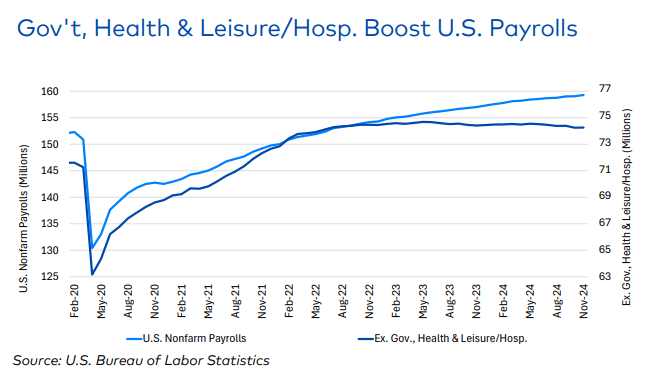
If you remove government and hospitality/leisure jobs from the payroll reports, jobs have been stagnant and declining for over 2 years. The new administration’s focus on cutting government spending could slow government job growth and provide room for the Fed to cut rates more dramatically.
The cost to purchase a home vs. renting remains at a historically high, a tailwind for rent prices entering 2025:
Lower vacancies, higher rents – The last few years have seen historic levels of new apartment construction, but that’s begun to ease. According to CBRE, multifamily construction starts should be 30% below pre-pandemic averages by mid-year. For that reason, 2025 should begin to bring about lower vacancies and 2.6% higher rents in the midst of continued strong renting demand.
Growing apartment appeal – Uncertainty gripping the housing market and a cloudy interest rate picture is leading many would-be home buyers to pick renting instead of purchasing. Benefits traditionally associated with renting –flexibility, freedom from maintenance, opportunities to meet new friends – will be prioritized by those who in earlier generations likely would have been home buyers. The trend is reflected in the National Association of Realtors Profile of Homebuyers and Sellers, revealing median home buyer age has risen from 35 to 38. It’s also seen in Entrata’s New American Dream Report, divulging that 66% of renters report renting rather than homeownership is a better lifestyle match for them.
AI spurs personalization – As AI continues to mature in the year ahead, the repetitive tasks traditionally undertaken by multifamily community property managers and staff will increasingly be assumed by technology. That should liberate apartment community employees to attend in more personalized ways to residents’ preferences. The coming year should witness a surge in new apartment community amenities, such as community concierge services, that will enable residents to build more robust social ties with fellow residents and staff.
U.S. banks will face continued pressure from commercial real estate (CRE) in 2025, but stresses and potential losses are expected to remain within ratings sensitivities for most lend, as loan loss reserves should insulate bank performance and ratings.
The largest banks with assets over $100 billion have reported the highest levels of non-performing non-owner occupied CRE loans and charge-offs. However, overall relative exposure is much lower than for regional and mid-sized banks.
Credit losses are not likely to burden earnings in 2025. Most Fitch-rated banks have been proactively reserving against potential office CRE losses, while the large banks also benefit from diversified business models.
_____________________________________________
Third quarter multifamily volume saw the highest levels since 2022. Year-to-date volume was up 8.5% through Q3.














 Multifamily Market News