
Category: Uncategorized
The South Is Booming But Mississippi Is Not Participating
From the summer of 2022 to the summer of 2023, the U.S. population grew by 1.6 million people, with 1.4 million of them—almost 87%—in the South, according to U.S. Census Bureau estimates. But Mississippi essentially missed out on that growth. It gained just over 750 residents during the same period.
This October, according to U.S. Bureau of Labor Statistics data, Mississippi’s civilian labor force had shrunk 1.4% from what it was a decade earlier, even as the South’s workforce overall has grown exponentially.
Only about half of the graduates from Mississippi’s public universities work in the state three years after graduation. Many leave for growing metropolitan areas in other parts of the South. The state has had one of the highest poverty rates in the nation for years. About 12.6% of the state’s population under the age of 65 have a disability, compared with 8.9% overall in the U.S.
Troubles in the capital city of Jackson, the largest city, have pushed many to leave the state. Jackson has seen its population decline from 173,500 in 2010 to 146,000 in 2022, according to Census estimates.

U-Haul’s Top Growth States Of 2023
U-Haul calculates each state’s net gain (or loss) of one-way equipment from customer transactions in a calendar year. It shows the states people are moving to (highest on the list) and where they are leaving from (lowest on the list). The number in parenthesis is where the state ranked in 2022.
2023 U-Haul Growth States
| 1. | TEXAS (1) |
| 2. | FLORIDA (2) |
| 3. | NORTH CAROLINA (4) |
| 4. | SOUTH CAROLINA (3) |
| 5. | TENNESSEE (6) |
| 6. | IDAHO (10) |
| 7. | WASHINGTON (23) |
| 8. | ARIZONA (7) |
| 9. | COLORADO (11) |
| 10. | VIRGINIA (5) |
| 11. | NEVADA (13) |
| 12. | VERMONT (30) |
| 13. | UTAH (12) |
| 14. | WYOMING (33) |
| 15. | DELAWARE (27) |
| 16. | NEW MEXICO (19) |
| 17. | ARKANSAS (43) |
| 18. | GEORGIA (8) |
| 19. | SOUTH DAKOTA (31) |
| 20. | MINNESOTA (17) |
| 21. | MONTANA (18) |
| 22. | ALABAMA (20) |
| 23. | OHIO (9) |
| 24. | IOWA (21) |
| 25. | HAWAII (–) |
| 26. | WISCONSIN (16) |
| 27. | INDIANA (14) |
| 28. | MISSOURI (15) |
| 29. | KENTUCKY (26) |
| 30. | WEST VIRGINIA (25) |
| 31. | MAINE (29) |
| 32. | NORTH DAKOTA (37) |
| 33. | KANSAS (39) |
| 34. | ALASKA (41) |
| 35. | NEBRASKA (32) |
| 36. | RHODE ISLAND (40) |
| 37. | OREGON (22) |
| 38. | PENNSYLVANIA (24) |
| 39. | MISSISSIPPI (34) |
| 40. | NEW HAMPSHIRE (38) |
| 41. | OKLAHOMA (42) |
| 42. | CONNECTICUT (28) |
| 43. | NEW YORK (46) |
| 44. | MARYLAND (44) |
| 45. | LOUISIANA (35) |
| 46. | MICHIGAN (48) |
| 47. | NEW JERSEY (45) |
| 48. | ILLINOIS (49) |
| 49. | MASSACHUSETTS (47) |
| 50. | CALIFORNIA (50) |
The South Experienced More Apartment Demand Than All Other Regions Combined In 2023
Half of all new multifamily supply went to the South in 2023. However, the relative deficits and vacancy spikes (70 – 100 bps) were similar in every region of the country. Why? The South also had the vast majority of the demand, more than all the other regions combined.

Atlas Van Lines’ Top 10 States For Inbound Migration In 2023
The South accounted for 87% of the country’s population growth in 2023, with a net migration of 1.4 million new residents, of which over 700,000 were domestic. The Midwest and West have both seen modest gains, while the Northeast’s population has fallen 0.1%.
Top 10 states for inbound/outbound moves in the continental U.S.
| Inbound | Outbound |
|---|---|
| 1. Maine | 1. Illinois |
| 2. North Carolina | 2. Pennsylvania |
| 3. New Hampshire | 3. Louisiana |
| 4. Montana | 4. Minnesota |
| 5. Washington | 5. Indiana |
| 6. Arkansas | 6. Oregon |
| 7. Florida | 7. Iowa |
| 8. New Mexico | 8. Mississippi |
| 9. District of Columbia | 9. New York |
| 10. Texas | 10. Ohio |
North and South Carolina Single-Family Home Price Growth and Affordability Entering 2024
The following chart shows the percentage gains (or declines) for home values over a 1, 3 and 12 month period in the Carolinas.
The last column shows the percentage of the median income it takes to make a home payment (principle, interest, taxes and insurance) in that city. It assumes a 5% down payment and 30-year mortgage rates at 6.5%, which is where they were as of this morning.
Historically, borrowers were considered safe if less than 28% of their monthly payment was going to toward the mortgage payment. As of this month, every single city is above 28% with most significantly above, and that is coming off a massive decline in mortgage rates over the last 60 days (they were above 8% at the end of October).
| City | State | Monthly | 3 Month | Annual | % |
| Anderson | SC | 0.07% | -0.06% | 9.50% | 42% |
| Graham | NC | 0.47% | 1.97% | 8.70% | 48% |
| Fayetteville | NC | 0.40% | 1.47% | 8.10% | 38% |
| Jacksonville | NC | 0.58% | 1.66% | 7.90% | 42% |
| New Bern | NC | 0.38% | 1.12% | 7.80% | 42% |
| Tarboro | NC | 1.03% | 2.36% | 7.70% | 29% |
| Charleston | SC | 0.84% | 3.50% | 7.30% | 60% |
| Goldsboro | NC | 0.28% | 0.82% | 7.20% | 40% |
| Oxford | NC | 0.43% | 1.34% | 7.00% | 41% |
| Aberdeen | NC | 0.46% | 1.05% | 6.90% | 38% |
| Sanford | NC | 0.26% | 1.22% | 6.60% | 45% |
| Shelby | NC | -0.83% | -1.62% | 6.60% | 38% |
| Asheboro | NC | 0.51% | 2.38% | 6.40% | 45% |
| Butner | NC | 0.22% | 0.68% | 6.30% | 32% |
| Greenville | NC | 0.28% | 1.31% | 6.20% | 38% |
| Henderson | NC | 0.79% | 1.34% | 6.20% | 34% |
| Lexington | NC | 0.55% | 2.43% | 6.20% | 51% |
| North Charleston | SC | 0.59% | 2.16% | 6.20% | 42% |
| Wilmington | NC | 0.35% | 1.20% | 6.10% | 57% |
| Burlington | NC | 0.43% | 1.65% | 6.00% | 35% |
| Boone | NC | 0.33% | 1.26% | 5.80% | 79% |
| Siler City | NC | 0.13% | 0.63% | 5.80% | 45% |
| Elkin | NC | 0.39% | 1.76% | 5.70% | 36% |
| Rocky Mount | NC | 0.58% | 1.93% | 5.70% | 36% |
| Wilson | NC | 0.24% | 0.81% | 5.70% | 47% |
| Chapel Hill | NC | 0.41% | 2.03% | 5.60% | 61% |
| Elizabeth City | NC | 0.72% | 2.35% | 5.60% | 39% |
| Lenoir | NC | 0.55% | 2.24% | 5.40% | 40% |
| King | NC | 0.52% | 1.81% | 5.30% | 35% |
| Southern Pines | NC | 0.16% | 0.51% | 5.00% | 55% |
| High Point | NC | 0.25% | 1.40% | 4.80% | 38% |
| Morganton | NC | 0.44% | 1.82% | 4.70% | 44% |
| Winston-Salem | NC | 0.60% | 2.43% | 4.70% | 40% |
| Laurinburg | NC | 0.31% | 1.24% | 4.60% | 33% |
| Newport | NC | 0.36% | 0.85% | 4.60% | 44% |
| Waynesville | NC | 0.50% | 40.51% | 4.60% | 56% |
| Hillsborough | NC | 0.49% | 1.88% | 4.50% | 47% |
| Greensboro | NC | 0.31% | 1.34% | 4.40% | 37% |
| Pinehurst | NC | 0.16% | 0.62% | 4.40% | 58% |
| Hickory | NC | 0.42% | 1.35% | 4.20% | 46% |
| Wilkesboro | NC | -0.26% | 0.11% | 4.20% | 49% |
| North Myrtle Beach | SC | 0.62% | 1.34% | 4.20% | 51% |
| Columbia | SC | 0.34% | 1.10% | 4.10% | 37% |
| Lincolnton | NC | 0.35% | 1.77% | 4.00% | 41% |
| Spartanburg | SC | 0.50% | 2.06% | 4.00% | 38% |
| Asheville | NC | 0.59% | 1.95% | 3.90% | 66% |
| Goose Creek | SC | 0.46% | 1.52% | 3.90% | 40% |
| Sumter | SC | 0.02% | 0.32% | 3.80% | 31% |
| Kinston | NC | 0.36% | 0.52% | 3.70% | 32% |
| Lumberton | NC | 0.10% | 0.37% | 3.70% | 34% |
| Pittsboro | NC | 0.16% | 0.66% | 3.60% | 57% |
| Hendersonville | NC | 0.23% | 1.05% | 3.40% | 56% |
| Greenville | SC | 0.44% | 1.14% | 3.40% | 40% |
| Clemmons | NC | 0.29% | 1.12% | 3.20% | 41% |
| Jamestown | NC | 0.10% | 0.67% | 3.20% | 49% |
| Arden | NC | 0.50% | 1.68% | 3.00% | 52% |
| Easley | SC | 0.20% | 0.48% | 3.00% | 41% |
| Creedmoor | NC | 0.18% | 0.80% | 2.70% | 41% |
| Salisbury | NC | 0.37% | 1.24% | 2.40% | 42% |
| Statesville | NC | 0.26% | 1.21% | 2.20% | 45% |
| Carthage | NC | -0.07% | 0.37% | 2.10% | 39% |
| Kernersville | NC | 0.27% | 1.04% | 2.10% | 40% |
| Leland | NC | 0.15% | 0.46% | 2.10% | 50% |
| Florence | SC | 0.54% | 0.86% | 1.90% | 32% |
| Greer | SC | 0.21% | 0.76% | 1.80% | 38% |
| Summerville | SC | 0.28% | 1.01% | 1.80% | 44% |
| Boiling Springs | SC | 0.25% | 1.26% | 1.70% | 41% |
| Duncan | SC | 0.29% | 1.26% | 1.60% | 37% |
| Orangeburg | SC | 0.43% | 0.46% | 1.50% | 42% |
| Apex | NC | 0.25% | 1.10% | 1.40% | 39% |
| Mebane | NC | 0.19% | 1.30% | 1.40% | 43% |
| Simpsonville | SC | 0.11% | 0.50% | 1.40% | 37% |
| Durham | NC | 0.33% | 1.21% | 0.90% | 49% |
| Raleigh | NC | 0.06% | 0.46% | 0.90% | 46% |
| Charlotte | NC | 0.41% | 1.59% | 0.80% | 46% |
| Shallotte | NC | -0.05% | -0.21% | 0.80% | 50% |
| Myrtle Beach | SC | -0.02% | 0.24% | 0.30% | 46% |
| Conway | SC | 0.19% | 0.37% | -0.30% | 50% |
| Lancaster | SC | 0.26% | 0.82% | -0.50% | 50% |
| Morrisville | NC | 0.24% | 0.67% | -1.20% | 37% |
| Clayton | NC | 0.06% | 0.16% | -3.20% | 39% |
| Gaffney | SC | -1.10% | -4.20% | -4.80% | 45% |
| Newberry | SC | 0.16% | -1.05% | -9.00% | 35% |
Multifamily CMBS Distress Rises Again To Start 2024
After a brief decline in November, distress in multifamily CMBS loans U-turned higher again in to finish the year. The chart below shows the percentage of multifamily CMBS loans delinquent, with special servicers or unable to be paid off at maturity (green line).
It’s important to note that CMBS loans make up a small percentage of the multifamily pie, but they provide more transparent information compared to other loan types.
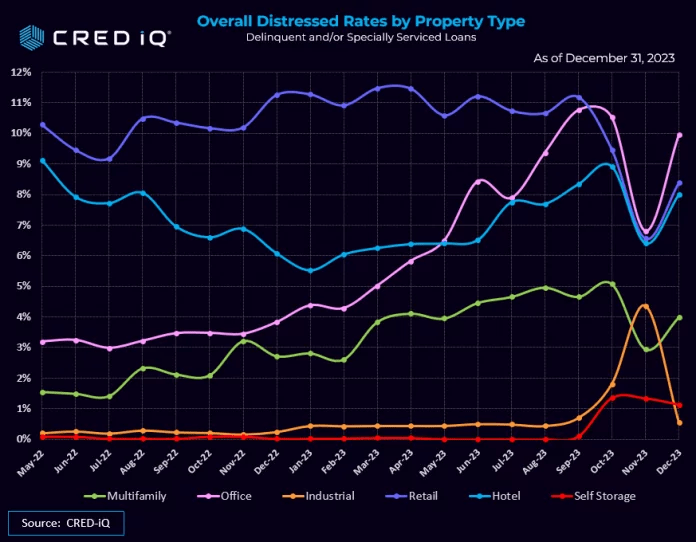
Industrial saw a large drop in December as a few very large loans were able to get worked out.
Multifamily Rent Performance By City In North & South Carolina Entering 2024
Every city showed rent declines month-over-month and the last quarter of 2023. Only two (Rock Hill and Garner) managed to barely stay positive over the last six months.
| City | 1 Month | 3 Month | 6 Month | 1 Year |
| High Point, NC | -0.80% | -3.38% | -7.00% | -11.01% |
| Matthews, NC | -1.21% | -4.45% | -5.89% | -6.64% |
| Wilmington, NC | -0.92% | -2.40% | -3.95% | -4.38% |
| Morrisville, NC | -0.40% | -4.79% | -7.44% | -4.35% |
| Raleigh, NC | -1.15% | -3.27% | -4.13% | -2.97% |
| Cary, NC | -0.93% | -2.42% | -3.43% | -2.68% |
| Durham, NC | -1.23% | -3.32% | -3.80% | -2.01% |
| Simpsonville, SC | -0.90% | -2.88% | -5.09% | -1.46% |
| Burlington, NC | -1.16% | -3.39% | -3.15% | -0.75% |
| Charleston, SC | -1.00% | -4.25% | -4.83% | -0.70% |
| Mount Pleasant, SC | -0.87% | -1.81% | -1.13% | 0.35% |
| Winston-Salem, NC | -1.57% | -4.15% | -3.32% | 0.80% |
| Mooresville, NC | -0.36% | -0.36% | -2.09% | 0.86% |
| Apex, NC | -0.72% | -2.83% | -2.95% | 2.30% |
| North Charleston, SC | 0.00% | 0.27% | -0.99% | 2.43% |
| Greenville, SC | -0.09% | -0.88% | -0.61% | 2.91% |
| Greensboro, NC | -0.54% | -2.72% | -3.58% | 2.94% |
| Chapel Hill, NC | -0.97% | -0.97% | -0.92% | 2.97% |
| Fayetteville, NC | -2.40% | -5.43% | -4.37% | 3.09% |
| Charlotte, NC | -1.00% | -2.49% | -2.13% | 3.18% |
| Rock Hill, SC | -0.46% | -0.18% | 0.89% | 3.25% |
| Garner, NC | -0.08% | -0.24% | 1.33% | 3.47% |
| Huntersville, NC | -0.90% | -0.90% | -2.07% | 4.08% |
| Gastonia, NC | -0.98% | -0.88% | -2.03% | 4.10% |
| Columbia, SC | -0.39% | -1.63% | -1.47% | 5.35% |
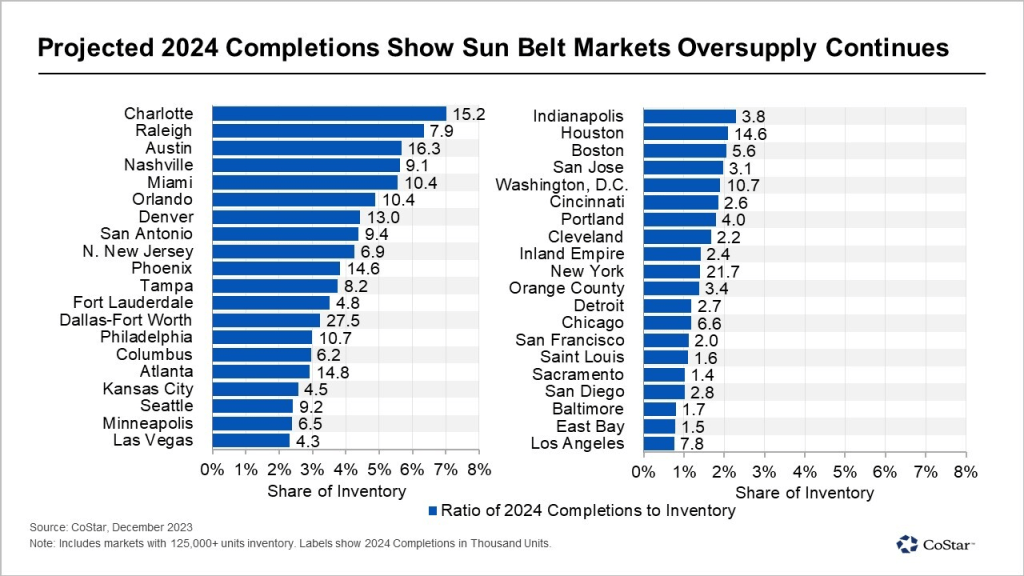
Projected 2024 Multifamily Completions As A Percentage Of Current Inventory
It’s more helpful to look at the increase in supply for a city based on the percentage of the current inventory vs. the total number of units.
1,000 new units added to Orlando with a population of 309,000 has a much larger impact than 1,000 new units added to Los Angeles with a population of 3,849,000.

 Multifamily Market News