
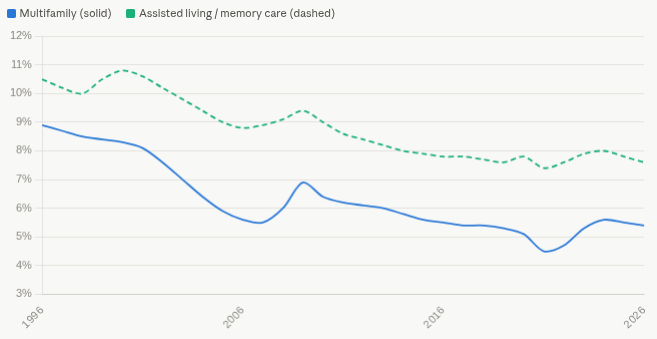
Assisted Living and Memory Care properties have always traded with a cap rate spread above multifamily. Why?
Operating Business Risk
- An apartment is a passive real estate asset; assisted living/memory care is a healthcare-adjacent operating business inside real estate. Buyers underwrite the operator as much as the building, and NOI can swing dramatically based on management quality.
- Operator dependence creates transition risk — replacing an underperforming operator is far more disruptive than swapping property managers on an apartment deal.
Labor Intensity
- Labor runs roughly 55-65% of operating expenses in AL (higher in memory care) versus ~25-30% for multifamily, so wage inflation, caregiver turnover, agency staffing costs, and staffing regulations hit NOI directly.
- The caregiver labor pool is structurally tight, and owners have limited ability to control that cost line.
Resident Turnover Economics
- Average length of stay is only 18-28 months in AL and roughly 18 months in memory care, versus 2-3 years for apartment tenants — meaning 40-60% of the rent roll must be re-leased every year just to hold occupancy flat.
- Move-outs are driven by health decline or death rather than lease expirations, and move-ins depend on emotionally difficult family decisions, making census harder to predict and market.
Regulatory and Licensing Exposure
- Communities are state-licensed and subject to surveys and inspections; a deficiency citation can damage reputation and census in ways multifamily never faces.
- Regulations (staffing ratios, care requirements) can change and compress margins with no offsetting revenue.
Liability and Litigation Risk
- Resident acuity creates negligence and wrongful-death exposure, especially in memory care, driving higher insurance costs and legal risk.
Thinner Capital Markets
- The buyer pool is smaller and more specialized than multifamily’s, reducing exit liquidity.
- Debt is less abundant — multifamily enjoys deep, consistent GSE support, while senior housing financing is narrower and more sensitive to credit cycles.
Higher Expense Loads and Margin Sensitivity
- Food service, care staff, transportation, and activities create a heavier expense structure, so a small revenue miss translates into a larger NOI miss than in multifamily.
Segment Risk Premium Scales with Care Level
- The market prices this explicitly: active adult trades nearly on top of multifamily, independent living slightly wider, assisted living wider still, and free-standing memory care widest (~9.5%+) — the more care in the model, the bigger the spread.

