Rapidly Rising Expenses Are Devastating Affordable Multifamily Properties

The affordable (rent restricted) multifamily sector is facing unprecedented margin pressure as operators confront a structural mismatch between revenue and costs.

Expenses at affordable communities have risen 38% since 2019, while income has only increased 32% over that same period.The six-point spread is not just a financial statistic but a lived reality on the ground, visible in tightening margins, deferred maintenance, and growing vulnerability to even modest external shocks.

Actual transaction data confirms NOI growth has been under acute pressure over the last several years, a phenomenon not seen with the same intensity on the market-rate side. While property-level revenues have trended upward in step with increases in area median income, expense growth has been less forgiving, driven primarily by surging payroll, maintenance, and utility costs. In many jurisdictions, these line items are up four to five percent year over year—a rate much higher on the affordable [side]…than on the market rate world.

The gravity of this trend becomes starker at the market and even sub-market level. In cities like Charlotte, operators have reported particularly acute challenges, where the expense load has been extremely difficult.

Some limited relief has come from a recent slowdown in insurance cost spikes, but this is far from enough to offset broad-based expense inflation.

The squeeze challenges the notion that affordable housing provides stability for both residents and owners. Turnover, typically much lower in affordable communities than in market-rate ones, has in some cases reached parity—a worrisome trend that may signal growing instability. Operators are forced to operate leaner, often delaying both routine and capital-intensive work.

Regulatory complexity itself is both a symptom and driver of higher operating costs, as subsidy layering and compliance requirements add about $20,000 per unit in development cost and significantly extend timelines, further stressing the operational side.

Source: Globe Street

Wall Street Journal: Weaker Job Market Slows Apartment Absorption

Renters across much of the U.S. have enjoyed easing prices and months of free rent this year. Now, this tenant-friendly environment looks poised to extend deep into next year, and perhaps beyond.

Apartment rents nationally are advancing at their slowest pace in years, thanks to the glut of new units that has taken longer than expected to absorb. More recently, job concerns among young people are posing a new threat to the rental market. 

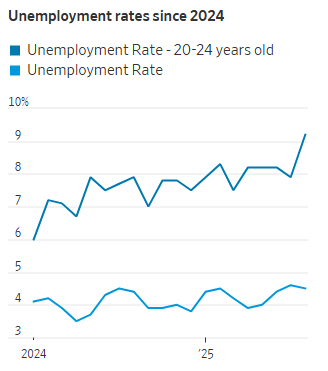
The U.S. unemployment rate for people aged 20 to 24 was 9.2% in August, more than double the overall rate. If a weaker job market continues, it could lead more of these renters to seek roommates or move back with their family, rather than get their own place. 

National rent prices edged slightly higher for part of this year, buoyed by price rises in the Northeast and Midwest where new supply has been limited. But last month, national average rent fell 0.3% from August, the steepest September drop in more than 15 years.

Multifamily owners and analysts anticipated that 2025 would be the year that surplus supply balanced out and they regained their pricing power. Instead, landlords are now betting on the ability to raise rents by the end of 2026, or at least sometime in 2027. 

Even that might be wishful thinking. Yardi Matrix recently lowered their projections for 2027 rent growth. They expect “more tepid” growth that year because of more new apartments coming online than originally expected. 

Previously reliable demand drivers are starting to fizzle. Hiring for entry-level jobs is tightening. Employment growth is decelerating. Apartments are getting leased at record levels. But that is largely because of all the supply and because building owners are offering more tenant incentives. They agreed to concessions such as months of free rent on 37% of rentals in September—a record for that month—according to Zillow. 

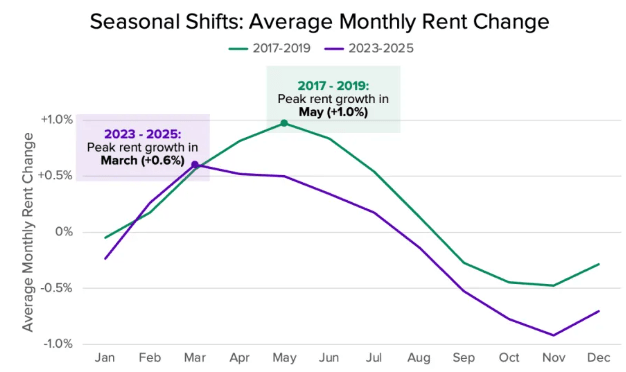
Some of the signs emerged this summer. Typically the hottest leasing season of the year, when college graduates start new jobs and rent new apartments, this summer saw national rent growth cool even further.

Source: Wall Street Journal

The Multifamily Bull Case: This Week’s Data

__________________________________________

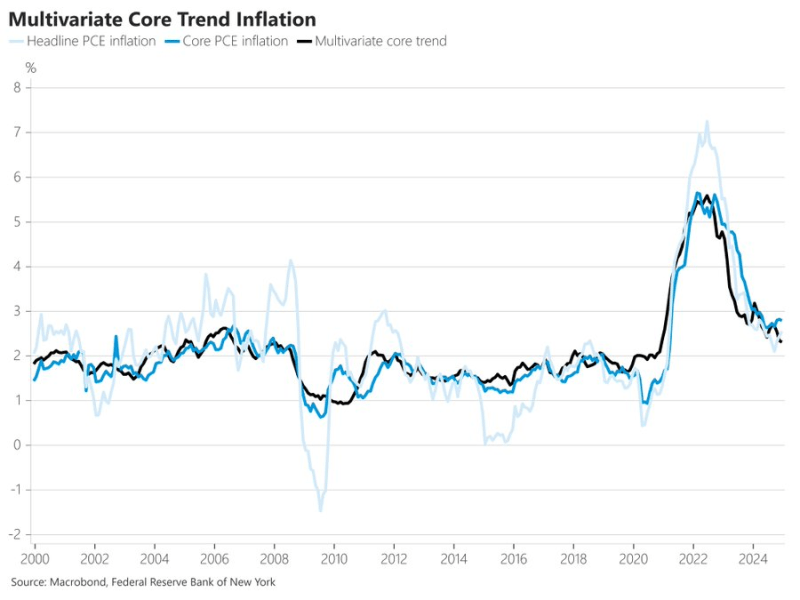
The NY Fed’s measure of inflation persistence (the “multivariate core trend”) fell to 2.3% in December, the lowest level in four years. Almost all of the overshoot relative to the pre-pandemic average comes from non-housing services.

___________________________________

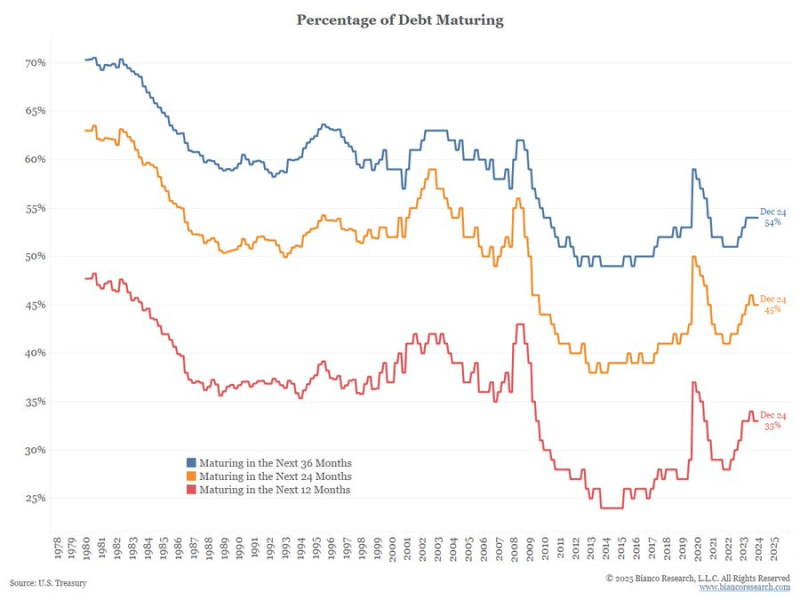
There’s been a fear cycle in the media recently talking about how 1/3 of the federal debt needs to be refinanced in the next year (and how this will negatively impact treasury yields). In reality, 1/3 of the debt always needs to be refinanced in the next year and about half always needs to be refinanced in the next 3 years. See below going back to the late 70’s:

____________________________________

The number of 1-person households continues to rise in the United States. Obviously, 1 person living alone has a far lower need to move out of an apartment to purchase a home.

________________________________

For the past year and a half, smaller apartment markets have garnered stronger rent growth than their large market counterparts. At the end of 2024, the annual change in effective asking rents among the nation’s largest 50 apartment markets (except New York) registered essentially flat at just 0.1%. Among smaller markets with an apartment base of about 24,000 units to just over 100,000 units, rent growth was considerably stronger at 1.4%.

This trend has been consistent since about mid-2023. While stronger rent growth among smaller markets can be inspired by lower inventory growth rates, the more likely scenario is that these markets are less likely to see drastic fluctuations in performance. Smaller markets display more resilience during hard times, missing the declines seen in bigger markets. At the same time, smaller locales don’t benefit from the same upside as larger markets during good times, either.

______________________________________

From this week’s Pensford Letter (2/3/25):

  • Last week brought the most recent Core PCE print. While the headline came out at 2.8%, most economists would say it’s really more like 2.3%. The monthly Core PCE was just 0.2%, annualizing at 2.4%.  That’s a better real time measure of inflation than comparing to where we were a year ago, which was 0.5% monthly rate (annualizing at 6%).
  • The 3-month Core PCE average is 2.3%, the 6-month average is 2.3%, and the 9-month average is 2.3%. If we strip out the one 0.5% outlier print from a year ago, the average is…wait for it…2.3%.
  • But you’ll say, “2.8% is above the Fed’s target!” Yes, but 2.8% is the mathematical consequence of measuring against a rapidly falling inflation a year ago, and the cost to immediately drive inflation to 2% is a lot of job losses (the Fed’s second mandate is full employment). If the Fed doesn’t expect inflation to reach 2% until the end of 2026, why is everyone acting like it needs to be 2% today?
  • What about tariffs? Tariffs are cognitively easy to grasp, which is why they are so easy to point to as a boost to inflation. But they don’t happen in a vacuum. Let’s say I am selling my Taylor Swift T-shirt for $20 today.  Tomorrow, I wake up and decide to change the price to $10,000. Is that inflation? No. Inflation happens after money exchanges hands. Someone has to pay that price in order for there to be inflation. When the price of something spikes, there is a drop in demand that partially offsets the cost increase. Or consumers shift to alternatives.

_____________________________________

The monthly Job Openings and Labor Turnover Survey (JOLTS) – released 2/4/25:

  • What It Is: Think of it as a “help wanted” jobs sign for the entire economy.
  • (1) Job Openings – How many jobs are available but not yet filled
  • (2) Hires – How many people actually got hired
  • (3) Quits & Layoffs – How many voluntarily left jobs (quits) or were let go (layoffs/firings)
  • Available positions fell by 556,000 to 7.6 million, the well below the estimate for 8 million.
  • What It Means: Weakness in the labor market will make the Fed more likely to cut rates in the months ahead

____________________________________