
When the US Census last issued long-run forecasts for the population, the main prediction was that it would decline for the first time in 2081. Based on a sharp reduction in new births and net migration, it could now happen as early as 2026.
In the year prior to July 1, 2025 the population grew by only 0.5%, or 1.8 million people, its lowest growth since the pandemic. There were 519,000 more births than deaths, however, by 2030 that surplus is likely to disappear altogether, making the US entirely dependent on immigration for population growth.
Net migration is expected to fall to only 316,000 in the year prior to July 2026, with the US “trending toward negative net migration.” What complicates the picture is that the Census estimates start and end midyear, and with Trump’s policy moving quickly, the official data isn’t keeping up. The Census calculations released this week don’t include the second half of 2025, when the immigration crackdown accelerated.
Recent work by the center-right American Enterprise Institute and center-left Brookings Institution suggests the US is already experiencing net negative migration. Diving into the data available on inflows and outflows of both legal and undocumented foreign-born workers, they calculated the US had a net decline in the immigrant population of 10,000 to 295,000 in 2025.
The biggest contributor to the slowdown in net migration has been a reduction in new arrivals rather than the high-profile deportations now receiving media attention.
If the low end of their 2026 prediction comes true and birth rates don’t spike in an unprecedented way, the US would have a decline of more than 400,000 in its overall population. Even at the midrange of their forecast, the country is at least flirting with a population decline.
Since the US began taking censuses in 1790, such a decline has never been recorded. The only potential asterisk was 1918, when the domestic US population shrank slightly as a consequence of the Spanish flu and because some 2 million US soldiers were deployed abroad.
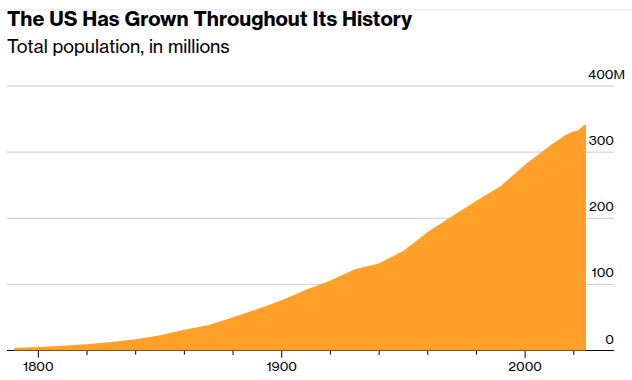
Source: Bloomberg
 Multifamily Market News