Positioning For The Real Asset Cycle

As investment allocations to private markets have grown, so has the need for discernment. Private markets are not monolithic, and their underlying drivers move differently through the cycle. Some strategies remain tightly linked to monetary policy; others are grounded in property level cash flows and long-term structural forces. As conditions evolve, so too must capital positioning.

At this point in the cycle, real asset strategies—particularly private real estate—stand out. Their drivers are rooted in tangible demand and operational execution, and their valuation and income profiles look distinctly different from other parts of the private markets landscape.

From an allocation standpoint, real assets stand out for a different reason: they are typically less reactive to short-term market sentiment, correlated instead to long-term structural forces, such as supply imbalances and operating performance. For investors, they offer a compelling proposition as the cycle shifts: income and value creation anchored in the real economy, while participating in the long-term upside potential of real assets.

Why Private Real Estate Now?

  • Income generation: Over the past two decades, more than 80% of long-term returns for a group of core private real estate funds tracked by NCREIF came from income. Notably, these distributions were tied to property level cash flows, including rents and lease structures, rather than policy rates. Those distributions can be highly tax efficient and, in many cases, competitive with or potentially superior to after tax yields from private corporate lending.
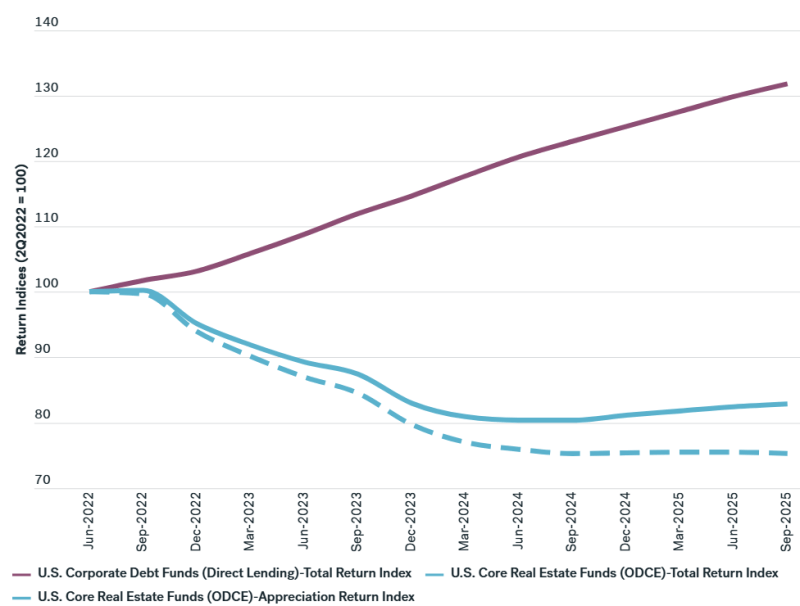
  • Cyclical upside potential: Real estate values remain below prior peaks after a significant reset that began in mid 2022. Over this period, private real estate underperformed private corporate debt; if performance were to revert toward historical relationships, closing that gap implies potential upside approaching 60%.
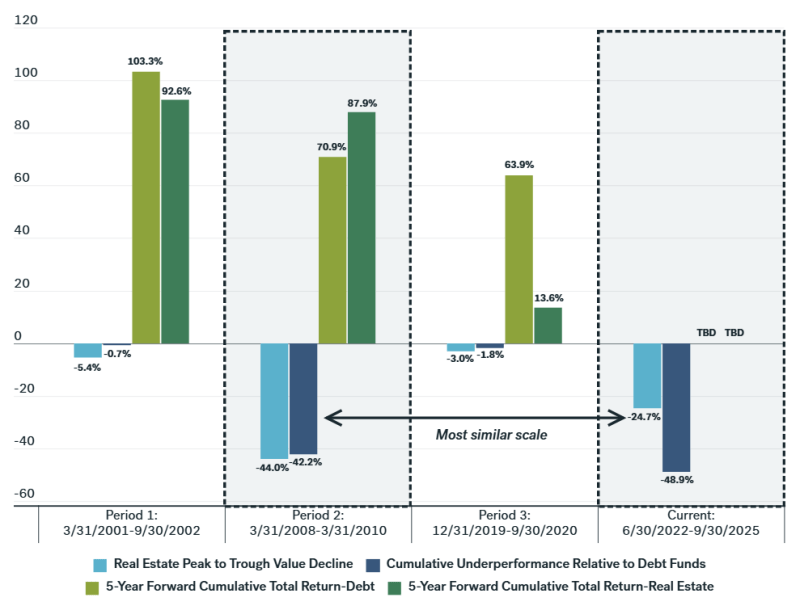
Looking across three comparable downturns, similar resets were followed by nearly 20% outperformance over the subsequent five years. Early signals have been giving a strong read that the turn is underway: core private real estate indices have now posted six consecutive quarters of positive returns after seven quarters of declines, suggesting the trough may be behind us.
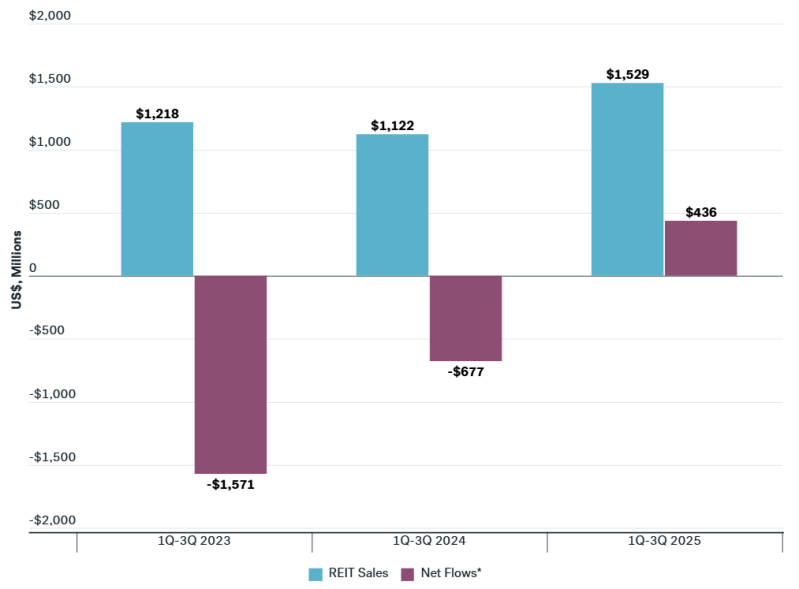
Capital flows show allocators are beginning to move. Among the largest non traded equity REITs, new investment activity has strengthened: capital raised over the first three quarters of 2025 is up 36% versus 2024, and net flows have shifted from negative to decisively positive. These are the kinds of signals we would expect as investors acknowledge the valuation reset and the compelling forward return profile of private real estate.
In today’s shifting environment, many investors risk finding themselves in overweight strategies whose strongest tailwinds are beginning to fade. After several years where elevated base rates created exceptionally strong income conditions, certain allocations now sit at cycle highs in portfolio weighting without the same income profile that supported them. Private corporate debt is one example of this dynamic at work: its role as a dependable income engine remains intact, but the forces that propelled its multi-year run have naturally been moderating.

At the same time, private real estate has been entering a very different part of the cycle, offering: 

  • potentially durable, property level income;
  • historically attractive entry valuation;
  • visible recovery potential; and
  • direct alignment with long term real asset demand.

Source: Hines
Multifamily REITs’ Discount To NAV: The Public vs. Private Cap Rate Spread

REIT stock prices are trading at levels well below net asset value. That makes buybacks more appealing. Bank of America REIT analyst Jana Galan said the REITs are trading at an implied cap rate around 6%. Meanwhile, we’re seeing REIT-quality apartments selling for cap rates ranging from mid-4s to low 5sThat’s a sizable gap that makes buybacks more attractive.

From multifamily REIT earnings calls last week:

EQR’s Mark Parrell said: “The best capital allocation opportunity we see now is to sell properties that we see as having lower forward return profiles and using the sales proceeds to buy back our stock. As you saw in the release, the company purchased approximately $206 million of its stock during the fourth quarter and just subsequent to quarter end for total stock purchases of $300 million in 2025. We see our company with its high-quality asset base and sophisticated operating platform as greatly undervalued in the public markets versus private market values. Also, by acquiring stock with the proceeds from the sales of slower growth properties, we’re effectively improving our forward growth rate as well, a double benefit.”

UDR’s Dave Bragg: “The magnitude of discount to NAV that has persisted in the space just doesn’t happen very often, and we are fortunate that we’ve taken advantage of it so far and plan to continue to do so as we execute on dispositions.”

Camden’s Ric Campo: Once Camden sells its SoCal portfolio, “We also look at the opportunity to redeploy the capital not only in the Sun Belt, but also to buy the shares. And so when we can sell the California portfolio at a cap rate that’s substantially less than our implied cap rate implied in our stock.”

IRT’s Jim Sebra: “Like a lot of our peers, there is a fundamental disconnect between implied cap rates as well as market cap rates. And we looked at that as a good opportunity … to buy back stock.”

Source: Jay Parsons

The Seasonal Multifamily Leasing Pattern Has Shifted

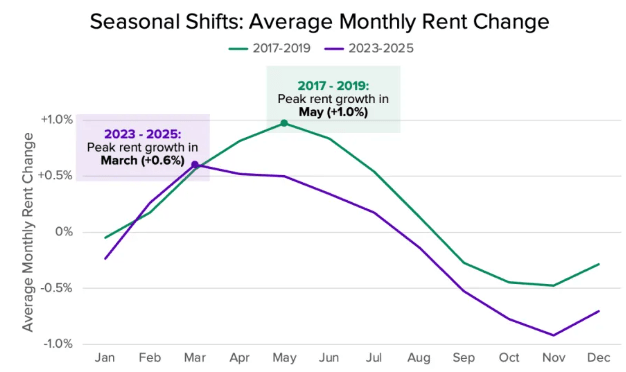
The rental market tends to follow an established seasonal pattern. More people generally move during the spring and summer, and rent prices normally rise accordingly as multifamily operators increase rents in response to the spike in demand. During the fall and winter months we tend to see the opposite: less moving activity, and operators pulling back on rents to attract the dwindling set of renters still on the market for a new home.

This seasonality results from three practical factors: school, weather, and holidays. The summer is more favorable for all three: if you are a student or have young children, you don’t need to juggle school schedules; weather is generally more temperate; and moving expenses aren’t being eaten up by holiday spending. Renters who have the flexibility and means to relocate during the winter will generally find lower prices and more wiggle room for negotiating lease terms.

Over the past three years, we’ve seen a noticeable shift in the timing of this seasonality. Since 2022, rental activity is more evenly distributed throughout the calendar year, annual rent declines exceed annual rent increases, and peak rent growth has moved up earlier in the year. 

From 2017-2019, the typical seasonal pattern was this: nationwide rents would rise for seven months from February through August, with peak rent growth (+1.0 percent) occurring in May.

Since 2023, there has only been six months of rent growth each year, from February through July, with peak rent growth down to +0.6% and occurring two months earlier in March.

These shifts are due to a combination of factors including:

  1. The persistent impact of a one-time shock to the timing of moves due to the pandemic
  2. An intentional shift by multifamily operator to spread out lease renewal dates
  3. A supply rich environment offering renters more optionality and flexibility in their moves

Source: ApartmentList

Rapidly Rising Expenses Are Devastating Affordable Multifamily Properties

The affordable (rent restricted) multifamily sector is facing unprecedented margin pressure as operators confront a structural mismatch between revenue and costs.

Expenses at affordable communities have risen 38% since 2019, while income has only increased 32% over that same period.The six-point spread is not just a financial statistic but a lived reality on the ground, visible in tightening margins, deferred maintenance, and growing vulnerability to even modest external shocks.

Actual transaction data confirms NOI growth has been under acute pressure over the last several years, a phenomenon not seen with the same intensity on the market-rate side. While property-level revenues have trended upward in step with increases in area median income, expense growth has been less forgiving, driven primarily by surging payroll, maintenance, and utility costs. In many jurisdictions, these line items are up four to five percent year over year—a rate much higher on the affordable [side]…than on the market rate world.

The gravity of this trend becomes starker at the market and even sub-market level. In cities like Charlotte, operators have reported particularly acute challenges, where the expense load has been extremely difficult.

Some limited relief has come from a recent slowdown in insurance cost spikes, but this is far from enough to offset broad-based expense inflation.

The squeeze challenges the notion that affordable housing provides stability for both residents and owners. Turnover, typically much lower in affordable communities than in market-rate ones, has in some cases reached parity—a worrisome trend that may signal growing instability. Operators are forced to operate leaner, often delaying both routine and capital-intensive work.

Regulatory complexity itself is both a symptom and driver of higher operating costs, as subsidy layering and compliance requirements add about $20,000 per unit in development cost and significantly extend timelines, further stressing the operational side.

Source: Globe Street

The Multifamily Bull Case: This Week’s Data

The Federal Reserve’s Interest Rate Decision, Statement & Press Conference – 3/19/25

The most significant part of the Fed’s statement is the reduction in the “redemption cap” on Treasury securities from $25 billion to $5 billion. This refers to the pace at which the Fed allows its balance sheet to shrink.

When Treasury securities on the Fed’s balance sheet mature, the Fed has a choice between doing nothing (a form of monetary tightening) or rolling over the position by buying new securities (a form of monetary ease or QE). By lowering the cap, there will be more rollovers and less balance sheet reduction. That is a dovish move that indicates monetary easing – a backdoor form of QE or even a rate cut.

The Fed lowered its inflation expectations and reduced its 2025 U.S. growth forecast from 2.1% to 1.7%. They also kept the unemployment forecast unchanged. Taken in combination with the decision to reduce the run-off in the balance sheet, this is a slightly dovish turn of events. It certainly strengthens the case for a rate cut at the Fed’s next meeting on May 7.

The U.S. unemployment rate hit an interim low of 3.4% in January 2023. From there, it rose to 3.9% in February 2024 then 4.2% in July 2024. Today, the unemployment rate is 4.1%, down slightly from last July but up significantly from January 2023. the labor situation and prospects for growth are worse than the headlines indicate. The household survey, a Labor Department survey different than the employer survey used to calculate the official unemployment rate, showed significant job losses in February. The number of employed individuals per the household survey dropped by 588,000. The Labor Force Participation Rate (total employed divided by total workforce) also dropped from 62.6% to 62.4%. 

Major U.S. companies are issuing warnings that earnings in the first quarter will not meet expectations. Walmart, Best Buy, Target, Kohl’s, American Airlines and Delta Airlines are among those who have revised earnings and revenue forecasts downward. These and other developments point in the direction of higher unemployment and slower growth (if not recession).

The Multifamily Bull Case: This Week’s Data

__________________________________________

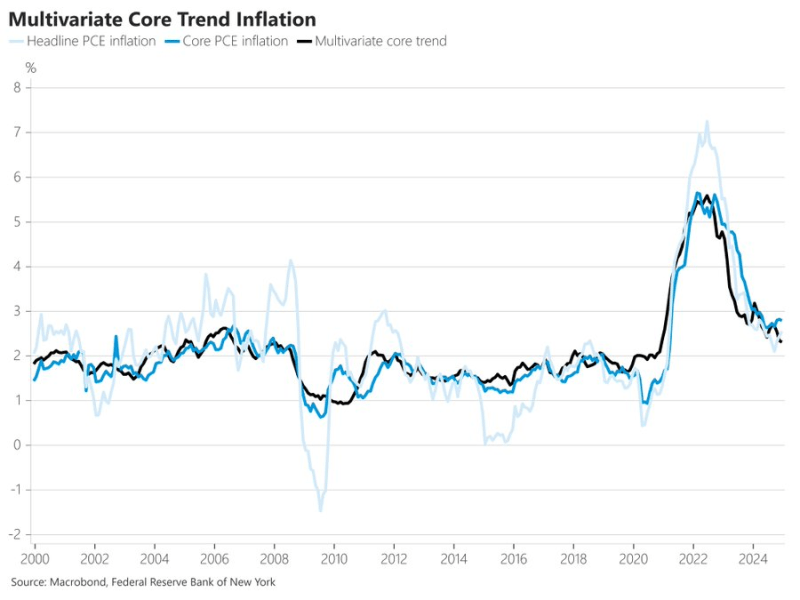
The NY Fed’s measure of inflation persistence (the “multivariate core trend”) fell to 2.3% in December, the lowest level in four years. Almost all of the overshoot relative to the pre-pandemic average comes from non-housing services.

___________________________________

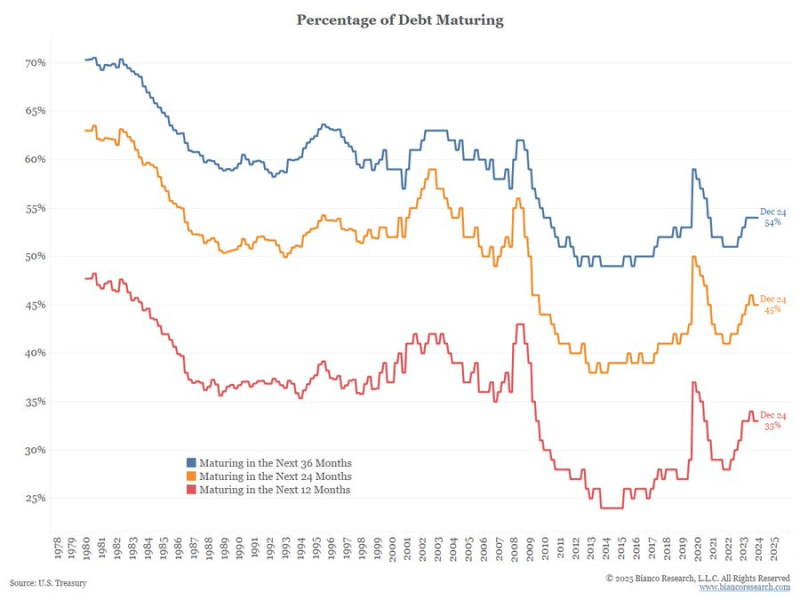
There’s been a fear cycle in the media recently talking about how 1/3 of the federal debt needs to be refinanced in the next year (and how this will negatively impact treasury yields). In reality, 1/3 of the debt always needs to be refinanced in the next year and about half always needs to be refinanced in the next 3 years. See below going back to the late 70’s:

____________________________________

The number of 1-person households continues to rise in the United States. Obviously, 1 person living alone has a far lower need to move out of an apartment to purchase a home.

________________________________

For the past year and a half, smaller apartment markets have garnered stronger rent growth than their large market counterparts. At the end of 2024, the annual change in effective asking rents among the nation’s largest 50 apartment markets (except New York) registered essentially flat at just 0.1%. Among smaller markets with an apartment base of about 24,000 units to just over 100,000 units, rent growth was considerably stronger at 1.4%.

This trend has been consistent since about mid-2023. While stronger rent growth among smaller markets can be inspired by lower inventory growth rates, the more likely scenario is that these markets are less likely to see drastic fluctuations in performance. Smaller markets display more resilience during hard times, missing the declines seen in bigger markets. At the same time, smaller locales don’t benefit from the same upside as larger markets during good times, either.

______________________________________

From this week’s Pensford Letter (2/3/25):

  • Last week brought the most recent Core PCE print. While the headline came out at 2.8%, most economists would say it’s really more like 2.3%. The monthly Core PCE was just 0.2%, annualizing at 2.4%.  That’s a better real time measure of inflation than comparing to where we were a year ago, which was 0.5% monthly rate (annualizing at 6%).
  • The 3-month Core PCE average is 2.3%, the 6-month average is 2.3%, and the 9-month average is 2.3%. If we strip out the one 0.5% outlier print from a year ago, the average is…wait for it…2.3%.
  • But you’ll say, “2.8% is above the Fed’s target!” Yes, but 2.8% is the mathematical consequence of measuring against a rapidly falling inflation a year ago, and the cost to immediately drive inflation to 2% is a lot of job losses (the Fed’s second mandate is full employment). If the Fed doesn’t expect inflation to reach 2% until the end of 2026, why is everyone acting like it needs to be 2% today?
  • What about tariffs? Tariffs are cognitively easy to grasp, which is why they are so easy to point to as a boost to inflation. But they don’t happen in a vacuum. Let’s say I am selling my Taylor Swift T-shirt for $20 today.  Tomorrow, I wake up and decide to change the price to $10,000. Is that inflation? No. Inflation happens after money exchanges hands. Someone has to pay that price in order for there to be inflation. When the price of something spikes, there is a drop in demand that partially offsets the cost increase. Or consumers shift to alternatives.

_____________________________________

The monthly Job Openings and Labor Turnover Survey (JOLTS) – released 2/4/25:

  • What It Is: Think of it as a “help wanted” jobs sign for the entire economy.
  • (1) Job Openings – How many jobs are available but not yet filled
  • (2) Hires – How many people actually got hired
  • (3) Quits & Layoffs – How many voluntarily left jobs (quits) or were let go (layoffs/firings)
  • Available positions fell by 556,000 to 7.6 million, the well below the estimate for 8 million.
  • What It Means: Weakness in the labor market will make the Fed more likely to cut rates in the months ahead

____________________________________