The Multifamily Bull Case: This Week’s Data

The Federal Reserve’s Interest Rate Decision, Statement & Press Conference – 3/19/25

The most significant part of the Fed’s statement is the reduction in the “redemption cap” on Treasury securities from $25 billion to $5 billion. This refers to the pace at which the Fed allows its balance sheet to shrink.

When Treasury securities on the Fed’s balance sheet mature, the Fed has a choice between doing nothing (a form of monetary tightening) or rolling over the position by buying new securities (a form of monetary ease or QE). By lowering the cap, there will be more rollovers and less balance sheet reduction. That is a dovish move that indicates monetary easing – a backdoor form of QE or even a rate cut.

The Fed lowered its inflation expectations and reduced its 2025 U.S. growth forecast from 2.1% to 1.7%. They also kept the unemployment forecast unchanged. Taken in combination with the decision to reduce the run-off in the balance sheet, this is a slightly dovish turn of events. It certainly strengthens the case for a rate cut at the Fed’s next meeting on May 7.

The U.S. unemployment rate hit an interim low of 3.4% in January 2023. From there, it rose to 3.9% in February 2024 then 4.2% in July 2024. Today, the unemployment rate is 4.1%, down slightly from last July but up significantly from January 2023. the labor situation and prospects for growth are worse than the headlines indicate. The household survey, a Labor Department survey different than the employer survey used to calculate the official unemployment rate, showed significant job losses in February. The number of employed individuals per the household survey dropped by 588,000. The Labor Force Participation Rate (total employed divided by total workforce) also dropped from 62.6% to 62.4%. 

Major U.S. companies are issuing warnings that earnings in the first quarter will not meet expectations. Walmart, Best Buy, Target, Kohl’s, American Airlines and Delta Airlines are among those who have revised earnings and revenue forecasts downward. These and other developments point in the direction of higher unemployment and slower growth (if not recession).


North & South Carolina New Multifamily Supply

More than 59,400 units are under construction across North and South Carolina with an expected 45,700 of those units coming online in 2025. Virtually all of those units underway across the Carolinas are concentrated in six of the region’s 10 markets:

  1. Charlotte, NC: The largest market in the Carolinas had 25,064 units underway at the end of 2024. No stranger to new apartment supply, Charlotte has grown total inventory nearly 29% over the last five years, well above the national pace of roughly 11%. The 18,863 units expected to deliver to Charlotte in 2025 would set a 29-year high. With those new units, Charlotte’s existing unit base would expand another 7.8%
  2. Raleigh/Durham, NC: 13,799 units under construction in 4th quarter 2024, with 10,353 of those units expected to complete in 2025. Those new units would increase the unit base 5.0% this year. That growth rate comes on the heels of a prolonged supply wave as this market has grown total inventory 25% in the last five years.
  3. Asheville, NC: Punching above its weight in terms of new supply, developers are expected to add 3,509 units this year in Asheville, a small market in western North Carolina’s Blue Ridge Mountains. That would grow the existing unit count (26,745 units) a massive13.1%, notably above the U.S. norm. Over the past five years, the inventory base in Asheville has expanded 19.7%.
  4. Charleston, SC: Jumping to the Atlantic coast of South Carolina, supply is expected to climb with 3,867 units under construction. The majority of those units (3,213 units) are projected to complete in 2025, expanding total inventory 4.2% this year. This market has experienced a much smaller supply wave then neighboring markets as total inventory here has only grown 4.9% in the last five years.
  5. Greensboro, NC: Apartment inventory has expanded roughly 7% over the past five years. At the end of 2024, there were 3,458 units under construction with 2,664 of those units scheduled to complete in 2025. That would expand total inventory another 2.3% this year.
  6. Wilmington, NC: 3,212 units were underway at the end of 2024. This year, 2,438 of those units are expected to complete, growing total inventory 8.0%. In the last five years, this market has grown total inventory a staggering 36%

Four other markets round out the 10 largest apartment markets in North and South Carolina.

  • Myrtle Beach, SC: 2,168 units of new supply in 2025, growing inventory 4.0%. Existing unit count has expanded 31.2% over the last five years.
  • Greenville/Spartanburg, SC: During the past five years, inventory ballooned 20.8%. Another 1,200 units are expected to deliver in 2025, increasing inventory 1.5%.
  • Fayetteville, NC and Columbia, SC: Two smaller markets, both are expected to add roughly 700 units in 2025.

Source: RealPage

The Multifamily Bull Case: This Week’s Data

__________________________________________

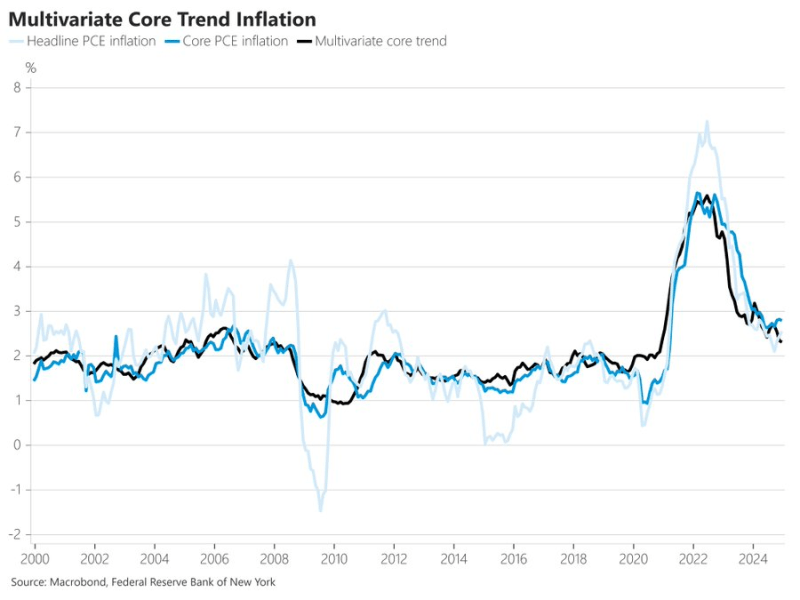
The NY Fed’s measure of inflation persistence (the “multivariate core trend”) fell to 2.3% in December, the lowest level in four years. Almost all of the overshoot relative to the pre-pandemic average comes from non-housing services.

___________________________________

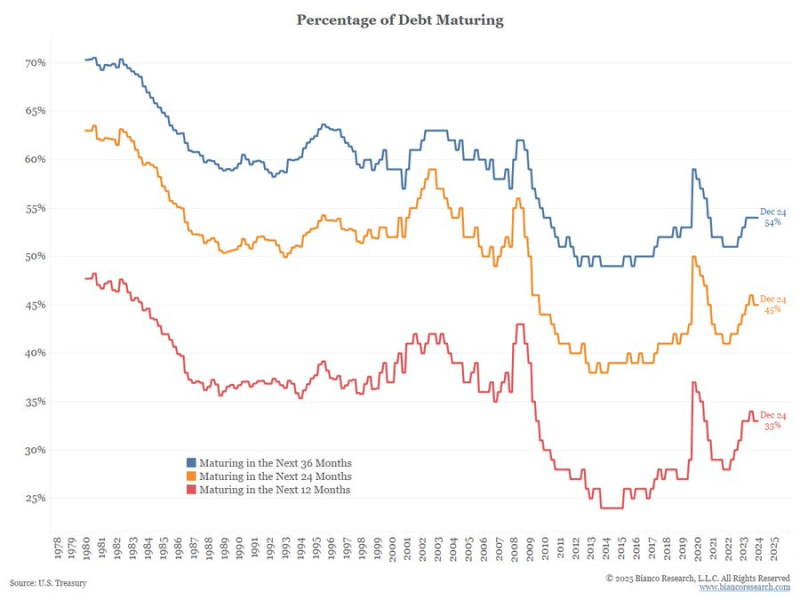
There’s been a fear cycle in the media recently talking about how 1/3 of the federal debt needs to be refinanced in the next year (and how this will negatively impact treasury yields). In reality, 1/3 of the debt always needs to be refinanced in the next year and about half always needs to be refinanced in the next 3 years. See below going back to the late 70’s:

____________________________________

The number of 1-person households continues to rise in the United States. Obviously, 1 person living alone has a far lower need to move out of an apartment to purchase a home.

________________________________

For the past year and a half, smaller apartment markets have garnered stronger rent growth than their large market counterparts. At the end of 2024, the annual change in effective asking rents among the nation’s largest 50 apartment markets (except New York) registered essentially flat at just 0.1%. Among smaller markets with an apartment base of about 24,000 units to just over 100,000 units, rent growth was considerably stronger at 1.4%.

This trend has been consistent since about mid-2023. While stronger rent growth among smaller markets can be inspired by lower inventory growth rates, the more likely scenario is that these markets are less likely to see drastic fluctuations in performance. Smaller markets display more resilience during hard times, missing the declines seen in bigger markets. At the same time, smaller locales don’t benefit from the same upside as larger markets during good times, either.

______________________________________

From this week’s Pensford Letter (2/3/25):

  • Last week brought the most recent Core PCE print. While the headline came out at 2.8%, most economists would say it’s really more like 2.3%. The monthly Core PCE was just 0.2%, annualizing at 2.4%.  That’s a better real time measure of inflation than comparing to where we were a year ago, which was 0.5% monthly rate (annualizing at 6%).
  • The 3-month Core PCE average is 2.3%, the 6-month average is 2.3%, and the 9-month average is 2.3%. If we strip out the one 0.5% outlier print from a year ago, the average is…wait for it…2.3%.
  • But you’ll say, “2.8% is above the Fed’s target!” Yes, but 2.8% is the mathematical consequence of measuring against a rapidly falling inflation a year ago, and the cost to immediately drive inflation to 2% is a lot of job losses (the Fed’s second mandate is full employment). If the Fed doesn’t expect inflation to reach 2% until the end of 2026, why is everyone acting like it needs to be 2% today?
  • What about tariffs? Tariffs are cognitively easy to grasp, which is why they are so easy to point to as a boost to inflation. But they don’t happen in a vacuum. Let’s say I am selling my Taylor Swift T-shirt for $20 today.  Tomorrow, I wake up and decide to change the price to $10,000. Is that inflation? No. Inflation happens after money exchanges hands. Someone has to pay that price in order for there to be inflation. When the price of something spikes, there is a drop in demand that partially offsets the cost increase. Or consumers shift to alternatives.

_____________________________________

The monthly Job Openings and Labor Turnover Survey (JOLTS) – released 2/4/25:

  • What It Is: Think of it as a “help wanted” jobs sign for the entire economy.
  • (1) Job Openings – How many jobs are available but not yet filled
  • (2) Hires – How many people actually got hired
  • (3) Quits & Layoffs – How many voluntarily left jobs (quits) or were let go (layoffs/firings)
  • Available positions fell by 556,000 to 7.6 million, the well below the estimate for 8 million.
  • What It Means: Weakness in the labor market will make the Fed more likely to cut rates in the months ahead

____________________________________