After a record 25 consecutive months of negative real wage growth, wages have now outpaced reported inflation on a year-over-year basis for 31 straight months.

Source: Charlie Bilello
After a record 25 consecutive months of negative real wage growth, wages have now outpaced reported inflation on a year-over-year basis for 31 straight months.

Source: Charlie Bilello
Publicly traded REITs (dark blue circles) currently have a higher occupancy and trade at a higher cap rate than private real estate (light blue circles) in the same category.

“I have less than 1 percent of my net worth outside of Berkshire, but basically I had that portion all in REITs. They were all small ones at that time. They were selling at discounts. At that time they were selling at discounts to the values of properties.”
– Warren Buffett 2005
“REITs are way more suitable for individual shareholders than for corporate shareholders. And Warren has enough residue from his old cigar-butt personality that when people became disenchanted with the REITs and the market price went down to maybe a 20% discount from what the companies could be liquidated for, he bought a few shares with his personal money. So it’s nice that Warren has a few private assets with which to pick up cigar butts in memory of old times – if that’s what keeps him amused.”
– Charlie Munger


Since 2000, apartment REIT implied cap rates and private transaction cap rates have both averaged ~6.2%. REIT cap rates were lower 48% of the time, and higher 52% of the time. When REIT cap rates are higher, it generally means the stock trades at a discount to Net Asset Value (often determined using the transaction cap rate), implying the underlying real estate is more valuable than ownership of REIT shares.
Transaction cap rates were lower than REIT implied cap rates for most of the 2000s, however, REITs traded at a premium from 2010 through 2019 (5.2% vs 6.0%). Since 2022, REIT implied cap rates have come in 50 to 150 bps lower than transaction cap rates, translating to a significant NAV discount. The current 100 bp spread (6.5% vs 5.4%) translates to a ~20% REIT NAV discount for apartments overall.


When MAA sees an acquisition opportunity, say a mid-2010s vintage mid-rise in Dallas – they will likely need to pay a low 5 cap rate. They could instead use the cash to buy their own shares back at a 6.7% cap rate – quite the difference. Furthermore, they could choose to dispose of this asset (as they already own a few mid-2010s midrises in Dallas) at a low 5 cap and use the proceeds to buy back shares.
Source: Wes Stayton’s LinkedIn
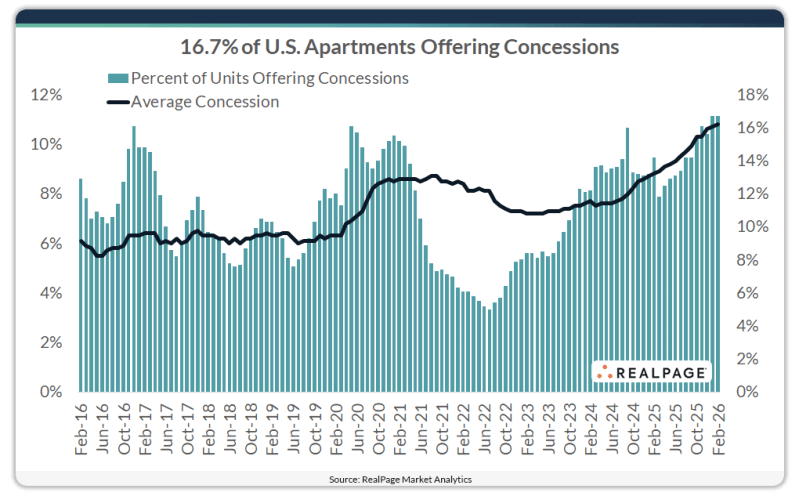
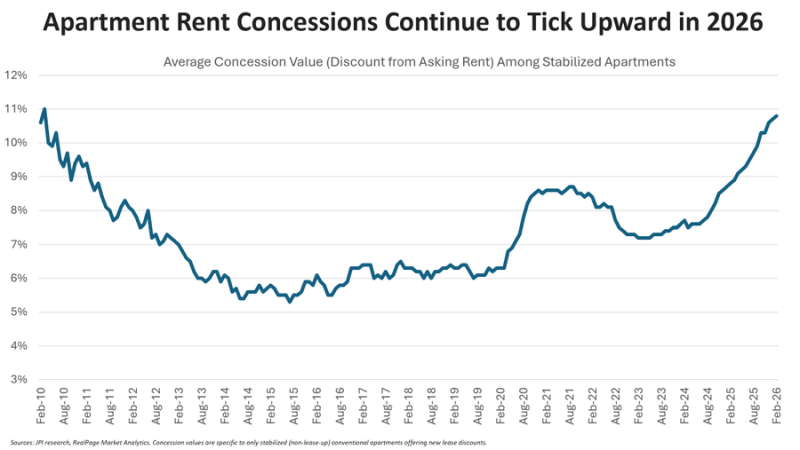
The use of concessions tend to be greatest during November and December as operators seek to capture renters from the reduced prospect pool. Those seasonal trends persisted throughout 2025. Nationwide, 16% of stabilized apartments offered concessions in November.
The average discount in November was 10.2%, the highest level since September 2024. By product class, concessions were greatest in Class A (10.8%) and Class C (10.3%) units, while Class B product posted a slightly smaller discount of 9.8%.
Meanwhile concession prevalence was overwhelmingly greatest in Class C units in November, with 20.7% of units offering discounts. Use of concessions in Class A and Class B was comparatively milder, hovering around 14%.

Source: RealPage
Trailing 4-quarter multifamily transaction volumes are 24% lower than 2018/2019 on a dollar basis and 42% lower on a unit basis.
With stabilized cap rates sitting at 5.3 percent, well below the long-term average of 6.2 percent, owners are generally holding their properties rather than accepting reduced values in a murky pricing environment.

Cap rates are lower than interest rates for the eighth consecutive quarter, meaning debt is dilutive to cash flow upon acquisition. Expense growth has outpaced revenue growth since 2023, negatively impacting NOI growth.

Source: John Burns
Among the top 20 U.S. markets for rent growth over the last 5 years, 16 of them are small, (mostly) non-institutional markets.

Source: Jay Parsons

Source: ULI Emerging Trends
To restore cost parity between owning and renting, mortgage rates would need to drop by about 2.5% from current levels, from 6.2% to 3.7%, holding other variables constant.

Source: Pretium
Fannie and Freddie’s lending caps have been increased by 20% for 2026 – providing $176 billion in new lending capital that will be available for the multifamily market. The FHFA, which sets the lending limits, said it will not lower them even if the market ends up smaller than projected.